Housing Affordability, Financial Stress and Mental Health
Working Yourself Insolvent in Canada

A nurse once sat across from me and cried as she explained how she was keeping up with her debts. She held two full-time jobs. During the working week, she slept about three hours a day and tried to catch up during the half-day on Sunday when she was not working. She was the sole income earner for a large family, and she was still making the minimum payments on her credit cards.

I also remember the man who wrote on his intake form, under reasons for financial difficulties, “cannot get enough overtime hours.” His description stayed with me because it made the dependence on extra work so plain. For a trustee, these encounters raise an immediate question. Does the Bankruptcy and Insolvency Act's definition of an “insolvent person” cover the person before me when payments are still being made, but keeping them current requires a workload that the person says they can no longer sustain? That is the question from which this article begins.
Those encounters lead from a trustee's assessment of an individual to the pressures behind the payments. We begin with the Canadian definition and a limited German comparison, asking how legislation can frame financial difficulty. We then examine Canadian housing costs and the delayed consequences of buying near a peak, followed by working time and research on debt, health and social connection. Japan and South Korea place those concerns in different housing-market settings. We return to practical financial choices, stress leave and debt solutions, with an appendix explaining the questions an early assessment should answer.
The trustee's question under section 2
Section 2 of the Bankruptcy and Insolvency Act, R.S.C. 1985, c. B-3, defines an “insolvent person” in these terms.
insolvent person means a person who is not bankrupt and who resides, carries on business or has property in Canada, whose liabilities to creditors provable as claims under this Act amount to one thousand dollars, and
(a) who is for any reason unable to meet his obligations as they generally become due,
(b) who has ceased paying his current obligations in the ordinary course of business as they generally become due, or
(c) the aggregate of whose property is not, at a fair valuation, sufficient, or, if disposed of at a fairly conducted sale under legal process, would not be sufficient to enable payment of all his obligations, due and accruing due; (personne insolvable)
The quotation is the section 2 definition, including paragraphs (a), (b) and (c).1
Keeping payments current does not, by itself, settle whether a person is insolvent under Canadian law. The Bankruptcy and Insolvency Act contains alternative tests, including inability, for any reason, to meet obligations as they generally become due, and property that, at a fair valuation or on a fairly conducted sale under legal process, would not be sufficient to pay all obligations, due and accruing due. A consumer proposal is open to an individual who is insolvent or already bankrupt, within a debt limit, subject to limited statutory bars. Eligibility cannot be determined from a missed-payment count alone.2
The ability-to-pay test looks a short way ahead: a person can be insolvent under it if payments will fall due in the immediate future and they do not have the means to meet them. The test is not directly concerned with whether the person has paid so far, so a record of payments made does not, by itself, answer it. Wanting to work less does not, by itself, make a person unable to pay; the law distinguishes inability from unwillingness. Nor does the statutory definition create a separate ground of insolvency based on exhaustion, housing costs or a desire for a healthier balance between work and life.3
She wanted to reduce her workload to one full-time job and one part-time job, and to put forward a consumer proposal based on what she could realistically keep earning. Her creditors did not welcome that position. Her payment record showed that she was keeping up. What she described to me was a way of living she could no longer sustain.
The nurse's circumstances required an individual assessment. On the information available to me at the time, I did not conclude that she met the statutory definition of an insolvent person. Her income then came from the two jobs she was actually working. I could examine her financial circumstances and exercise professional judgment within the law, but I could not set aside the income she was actually earning on the strength of a medical opinion of my own about what she should be able to sustain.
A person's actual reduction in work and income would give me different facts to assess. A doctor's opinion may also supply information that is outside my expertise. Neither example resolves the wider issue raised here. Trustees are accustomed to taking responsibility for exceptional circumstances. My concern is whether that individual approach is being asked to absorb a recurring affordability problem, particularly where housing costs have made unusually demanding work arrangements seem normal.
The Bankruptcy and Insolvency Act, including its definition of an insolvent person, the directives of the Office of the Superintendent of Bankruptcy, the Code of Ethics for Trustees and the assessment requirements provide the framework for my work. The health research does not replace those tools. It helps us examine the pressure being brought to them. The question for the profession is what we should learn when circumstances that once called for exceptional judgment begin to recur across our files.
One comparison with Germany
The Canadian definition is the test I must apply. It need not be the only way we think about how legislation should recognise financial difficulty. Germany provides a useful comparison, with conditions and procedures of its own.
Germany offers a specific comparison worth examining. When a debtor applies for insolvency proceedings, German law also accepts impending inability to pay as a ground, assessed as a rule over a 24-month forecast. Consumer proceedings, which are for individuals who are not, and have not been, self-employed (and for some formerly self-employed people with fewer than 20 creditors and no claims from employment relationships), add conditions: with the application, or promptly after it, the debtor must file a certificate from a suitable person or body that an out-of-court settlement with creditors on the basis of a plan was tried and failed within the previous six months, together with a debt settlement plan and lists of assets, income, creditors and claims. This is a defined route to earlier consideration of payment difficulty, not proof that Germany is more lenient overall. It provides a useful question for Canadian discussion: how should a system identify and respond to financial distress before default, while preserving fair eligibility and creditor safeguards?4
Why the housing peak still matters
The statutory question is the starting point. To understand why it keeps arising in practice, we need to widen the discussion. Housing, working conditions and health will not determine the legal answer by themselves. They matter because they help explain the circumstances that bring people to a trustee and the demands behind the income recorded in a household budget.
The housing charts also raise a fair question about timing. If the market peaked in 2022 and prices have since retreated, might the worst already be behind us? Two issues keep the article relevant. First, the remaining cost of housing can still be very high relative to income, even after an improvement from an extraordinary peak. Second, the consequences of buying at that peak can take years to work through a household's finances. A price decline can ease the entry price for a new purchaser while eroding the equity of someone who bought earlier.
Housing is the cost my debtors complain about most. For a household whose income is already committed, the cost of keeping a home helps determine how much work must be done, how much debt can be carried and how much room remains for an interruption. That is the part of financial stress and mental health I encounter as a Licensed Insolvency Trustee.
Canada’s housing-price retreat has brought some measures down from extraordinary peaks. It has not returned every household to an affordable position. A purchase made near a peak can leave financial commitments that outlast the market conditions in which they were taken on. A renter must still find the next month’s rent. An improvement from a very difficult starting point can be real while the remaining difficulty is substantial.
In the part of my practice where mental health and debt meet, I usually become involved after the financial event. The person is already on stress leave, income has fallen, and the rent, mortgage and other debt payments continue. Looking back, people tell me they wish they had addressed their debts earlier.
Trustees deal with exceptional cases. We examine individual circumstances, exercise professional judgment within the legal framework and carry responsibility for that assessment. My concern is what happens when the exceptional circumstances recur across many households. A housing bubble can change the financial arrangements people regard as normal, including the amount of work they believe they must undertake to keep up.
The charts below make that concern visible. They are financial and population evidence, not a clinical account of what happened to any one person. Read together with the research and the experiences people describe to a trustee, they help explain why the housing question belongs in a discussion of financial stress and mental health.
The housing bubble and the retreat from its peak
The Dallas Fed’s international database provides a longer perspective. Its measure comparing real house prices with real personal disposable income per working-age person, indexed to 2005, placed Canada at 194.3 in the first quarter of 2022 and 134.3 in the second quarter of 2026. On that same construction, the United States stood at 97.8, the United Kingdom at 95.4 and France at 89.4. Canada had moved a long way down from its peak but remained well above its own 2005 relationship between prices and incomes. These indices show changes within each country; they are not a comparison of the dollar cost of buying the same home in each place.5
Figure 1: The Canadian rise and retreat against selected peers
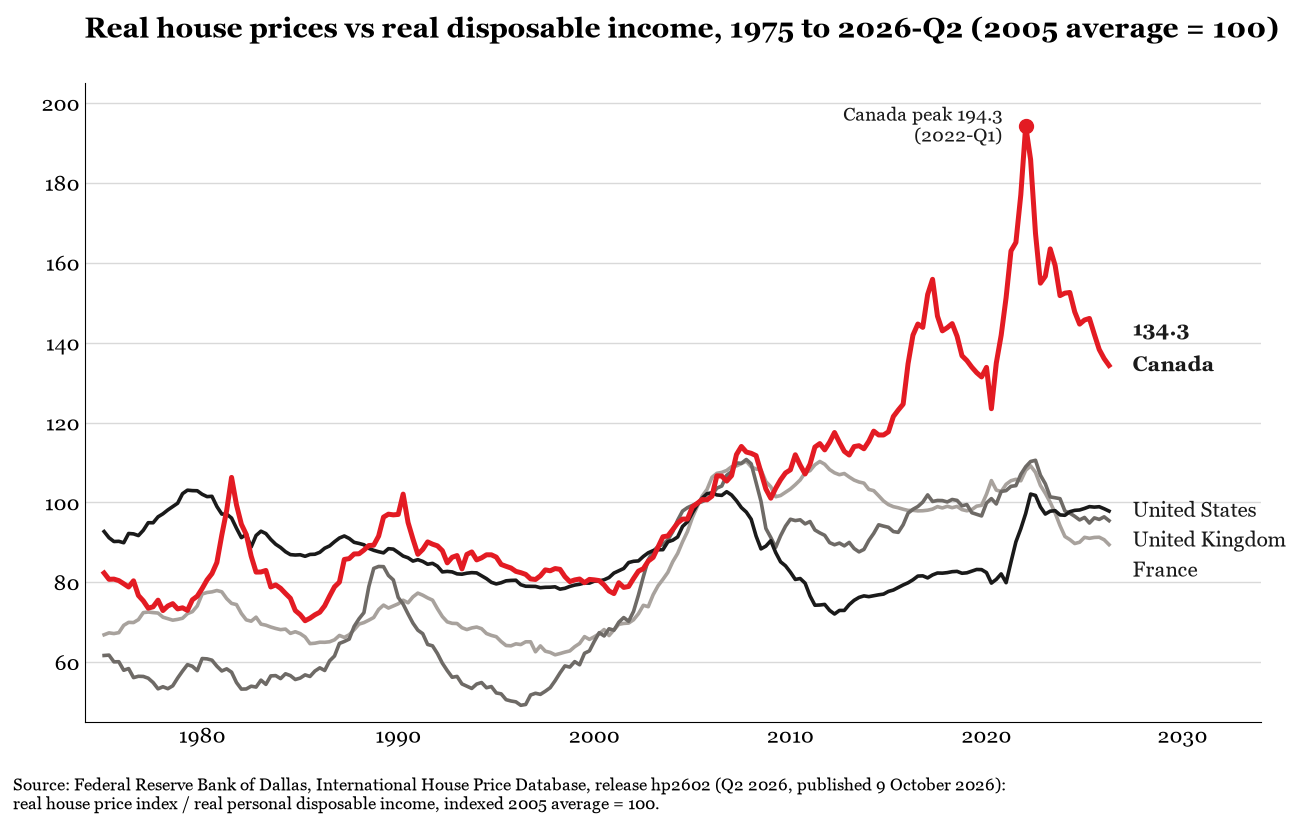
The Canadian line in Figure 1 rises far above its own 2005 relationship between house prices and incomes before turning down sharply. Among the four countries plotted, the Canadian departure from that baseline is the most pronounced at the peak. By the second quarter of 2026 the Canadian index had fallen substantially, but it was still 134.3 against its 2005 baseline of 100. The selected comparison countries were near or below their own baseline relationships. The ratio can move because prices change, incomes change, or both; its decline is not a percentage fall in house prices alone.
That fall is an improvement from the peak. It does not establish that a Canadian household can now comfortably afford its home. Nor does a lower market price automatically reduce an existing mortgage balance or the monthly commitments of someone who bought earlier.
Many of the debtors I meet who describe housing problems as taking a toll on their mental health trace at least part of the trouble to buying near the top of the market in 2022. The peak may be behind us; for these households, its consequences are still unfolding. The fall in their home's value has eroded much of the equity their down payment once provided, while the mortgages on title still have to be dealt with.
Some want to sell and move on, but the expected proceeds would not cover all the mortgages on the property. The market's retreat has made their home worth less without giving them a straightforward financial exit. This is the difficulty they bring to me when they say they want to walk away. Our guide to selling a home with debt considers the situation where a sale will not clear the mortgages.
When I look at that rise and retreat, I think about the people who have to live through it. The financial disruption has a human dimension even where the precise health effect cannot be read from the chart. The question worth investigating is what happens to sleep, family life and mental health when a housing commitment is maintained by consuming the time and energy on which the household also depends.
Canada’s housing-affordability problem has survived a substantial retreat from the price peak. In the OECD series used for this article, the Canadian house-price-to-income index fell from 138.0 in the first quarter of 2024 to 128.1 in the final quarter of 2025 and 126.1 in the first quarter of 2026. The index is set to 100 in 2015; it does not mean that a home costs 126 times a household’s income. The OECD’s 2025 survey of Canada also reported that real house prices had outpaced real disposable-income growth by about 60 per cent since the Global Financial Crisis. These dated measures describe the scale and persistence of the problem, rather than a claim that affordability has worsened in every recent quarter.7
Figure 2: House prices relative to incomes across OECD members
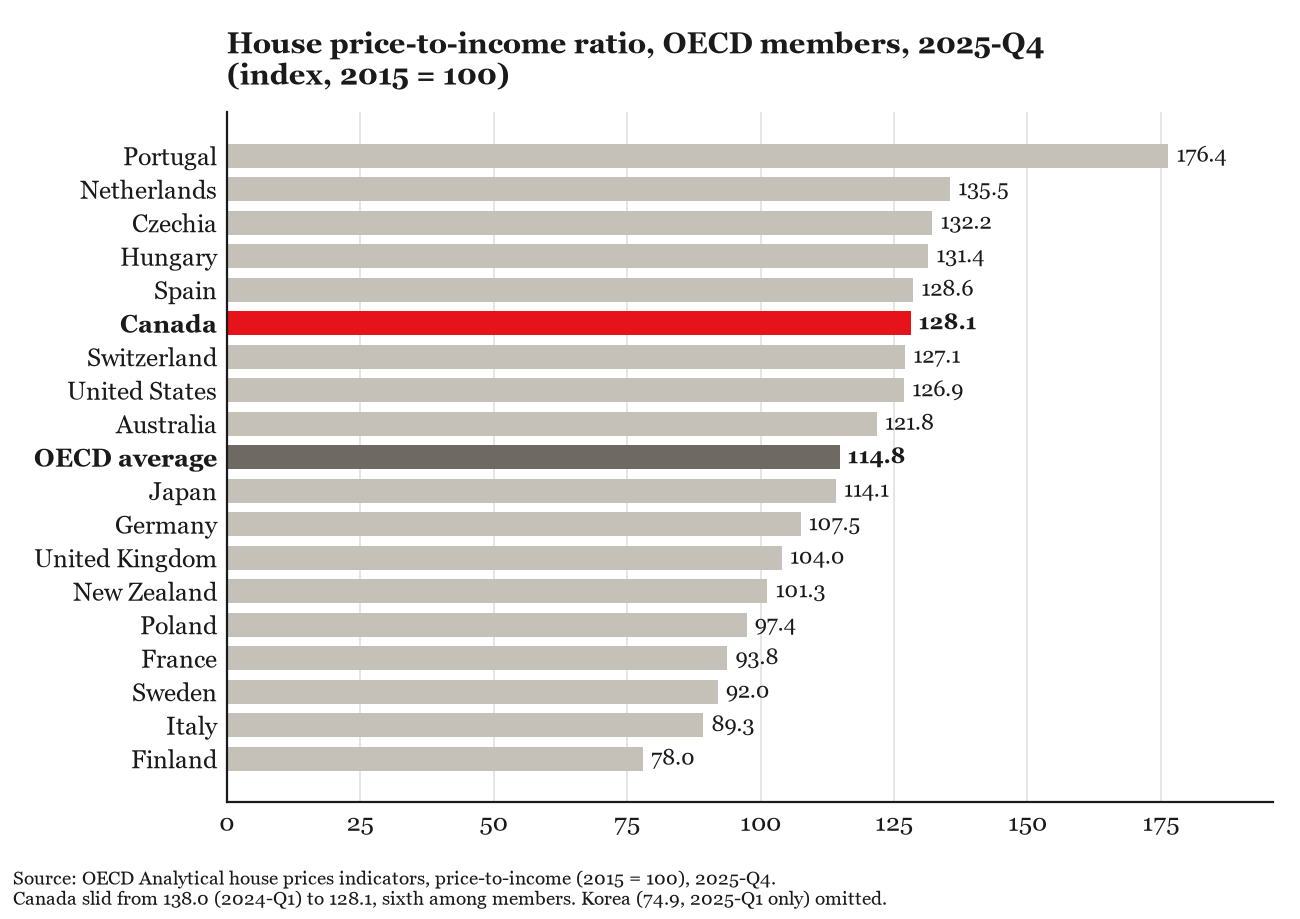
The OECD chart uses a 2015 baseline, rather than the 2005 baseline in Figure 1. It covers a different period and includes a wider set of countries. Canada’s price-to-income relationship had risen more than the OECD average from that baseline, although several countries, including Portugal, had larger increases. The Canadian problem is serious without needing to claim that every measure puts Canada in the worst position. A retreat from a peak and a continuing affordability problem can coexist.
For a household living paycheque to paycheque, a high income can coexist with little room to recover from an interruption. Someone who is house poor may have a substantial home and still have difficulty meeting current expenses. Mortgage stress and rent stress belong in a discussion of housing and mental health because the household must find the money each month, whatever has happened to the market value of the property. The housing cost burden is therefore also a question about income, time and financial resilience.
Renters face a related affordability problem. In its 2024 rental-wage update, the Canadian Centre for Policy Alternatives estimated that a full-time worker needed about $38 an hour to afford an average one-bedroom apartment in Toronto under a rent-to-income threshold of 30 per cent. Its estimate for a unit coming vacant was $41.73 an hour. Those are 2024 estimates, not a new November 2026 rent measurement. For a separate, current wage reference, Ontario’s general minimum wage rose to $17.95 an hour on 1 October 2026.9
There has been relief in some recent measures. The average one-bedroom rent in the Greater Toronto Area was about $2,246 in the first quarter of 2026, down 4.1 per cent from a year earlier. That decline matters to renters who can obtain the lower price. It does not tell us whether a particular household’s rent is affordable relative to its income.10
Rental arrears also need to be read with their dates attached. CMHC’s 2025 Rental Market Report described arrears declining across markets and rent-to-income ratios improving in Vancouver, Calgary and Toronto. That improvement belongs in the account. A persistent affordability problem does not mean that every indicator moves in the same direction every year.11
The picture for homeowners is uneven as well. CMHC’s fall 2026 mortgage report describes financial stress as contained nationally but rising in Ontario and British Columbia, with particular pressure in the Greater Toronto and Hamilton Area. It also identifies worsening payment performance on credit cards, car loans and lines of credit as a potential warning before mortgage arrears become more apparent. That is relevant to a practitioner looking beyond the mortgage payment alone.12
More recent survey evidence also shows some improvement. In the Bank of Canada's third-quarter 2026 consumer survey, respondents assessed their financial health more favourably than in the previous quarter, although high prices and uncertainty continued to weigh on spending plans. These are reported perceptions, not a measure of mental illness. They reinforce the need to distinguish an improving national picture from the difficulties particular households continue to face.13
The connection with health deserves attention, but also care. Longitudinal studies have associated housing disadvantage, including payment difficulties and unaffordable housing, with poorer mental health. Such designs can follow changes over time, yet they do not remove every alternative explanation. The evidence supports taking housing strain seriously as a health concern; it cannot identify the cause of an individual person’s illness from their housing costs alone.14
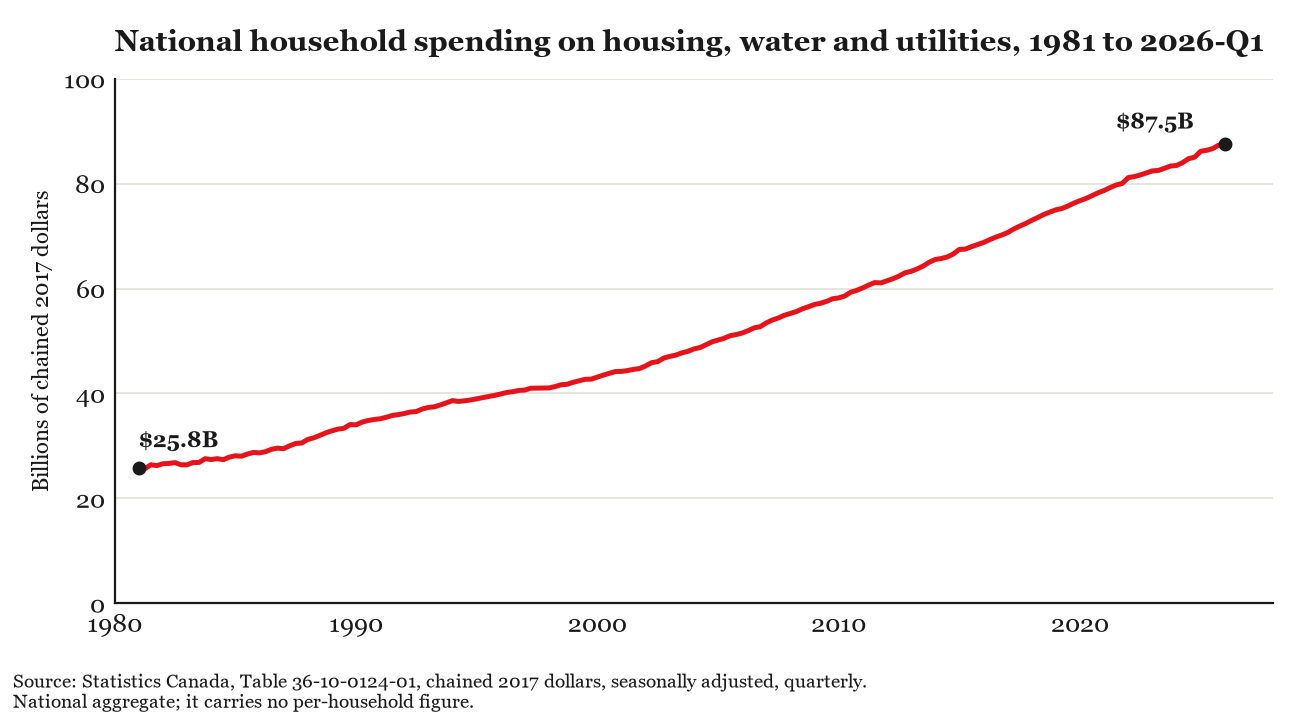
The price-to-income relationship is only one part of the housing story. Figure 3 shows the growth in national real spending on housing, water and utilities. The aggregate rose as the country and its households changed, so it cannot tell us how much more any particular family paid. It does show the expanding scale of resources devoted to shelter and related services. To understand strain on an individual household, we still need its own housing cost and income together.
Figure 3: The national scale of household shelter spending
What national debt payments can and cannot tell us
Household debt remains high, although the recent ratios have eased. Statistics Canada reported household credit-market debt of about $3.281 trillion in the second quarter of 2026. In its September release, debt relative to disposable income fell to 176.4 per cent from a revised 178.6 per cent in the first quarter, while the debt-service ratio declined to 14.52 per cent from 14.68 per cent. The debt-service ratio peaked at about 15.2 per cent in the first quarter of 2023. The Bank of Canada's 2026 assessment likewise describes indebtedness as elevated but below its 2022 peak, with financial pressure unevenly distributed across households.16
Figure 4: The share of disposable income committed to debt payments
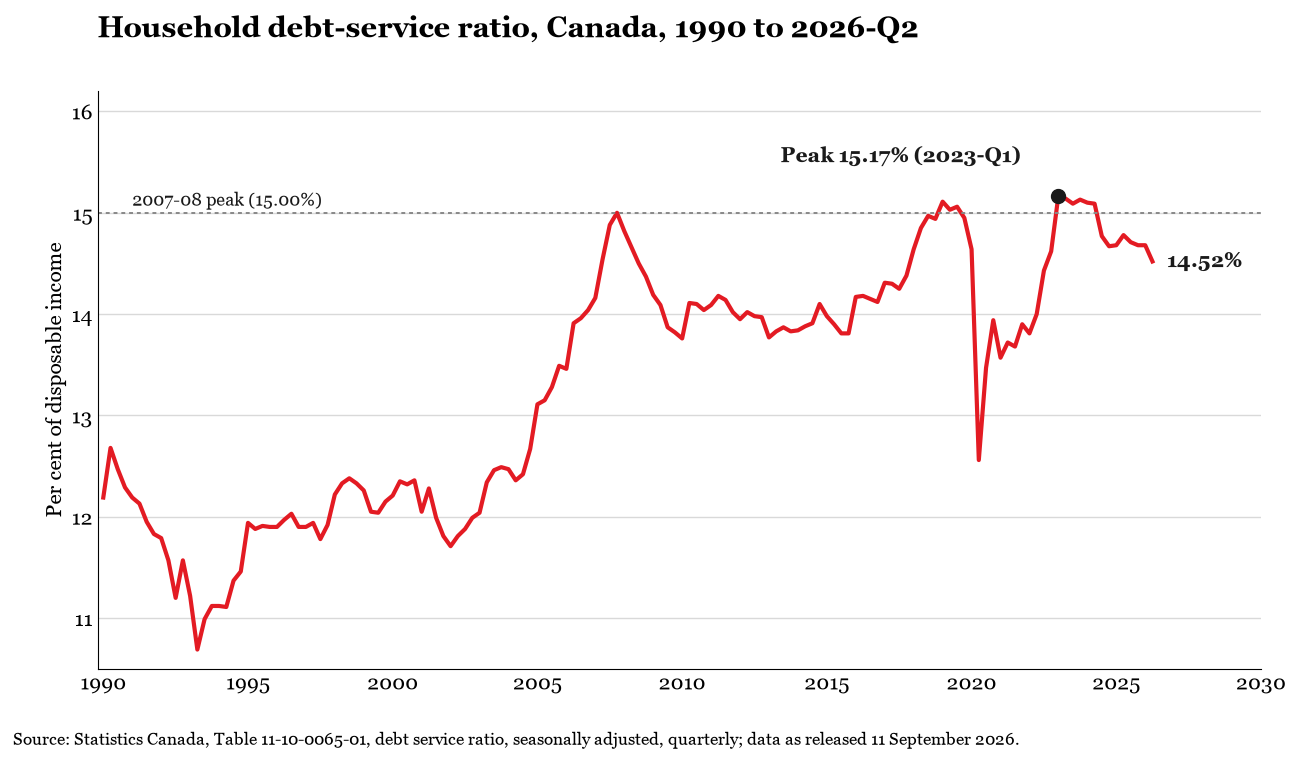
A declining national debt-service ratio is welcome. It does not identify the household whose income depends on extra shifts or whose finances would change sharply after a short leave from work. Those are the cases in which I need to understand the budget behind the payments, rather than assume that an improving aggregate has settled the person’s difficulty.
These are the conditions the people across my desk carry in with them. The next question is what households do under that pressure, and what the doing costs.
Financial pressure reaches beyond individual files
The charts have taken us from the individual file to household finances. I now widen the inquiry to financial stress and mental health because the payment record alone cannot describe the human experience that brought the nurse to my office. Dana Trentini brings her scientific research background to our reading of this evidence; I bring the questions arising in insolvency practice. The studies give those questions context without determining any individual's diagnosis or legal eligibility.
The latest national survey gives a timely measure of perceived pressure. In Mental Health Research Canada’s Poll 29, fielded from 27 July to 10 August 2026, 46 per cent reported a negative mental-health impact from the cost of living. The corresponding figures were 37 per cent for the possibility of being unable to pay household bills fully and 35 per cent for being unable to afford or have stable housing. These are responses about perceived mental-health impact. They are not estimates that 37 per cent actually failed to pay their bills or that 35 per cent were experiencing housing instability, and the survey does not establish causation.18
Figure 5: Financial pressures and reported mental-health impact
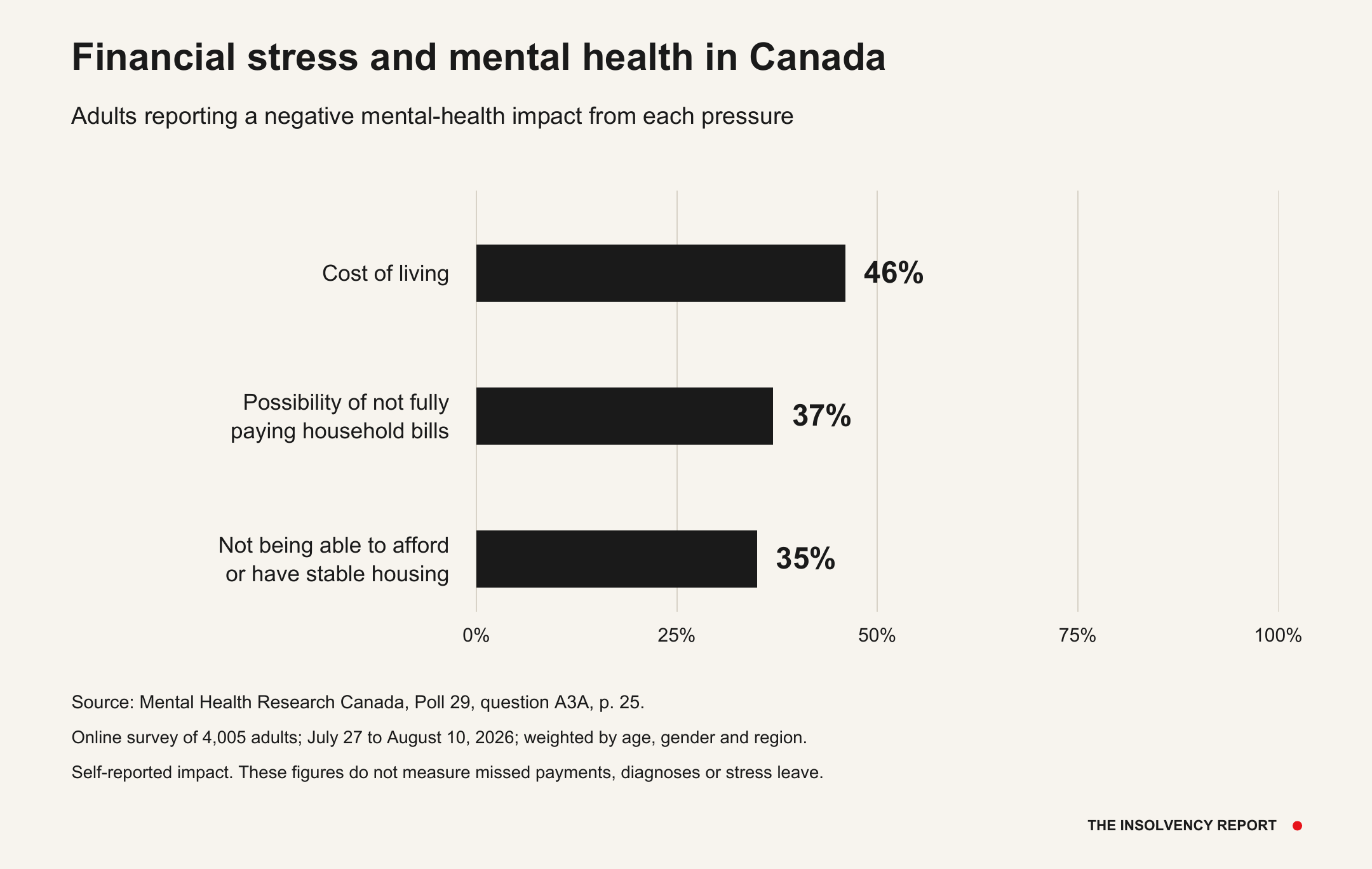
These national responses give the practice observations a wider setting. They do not establish that every financial difficulty is caused by housing, or that every person under financial pressure will become ill. They do show why financial health and mental health deserve to be considered together when examining the cost of living in Canada.

The hours behind the household budget
The nurse's two jobs and the man's difficulty obtaining enough overtime make working time part of the inquiry. This is a further step beyond the statutory definition, but it is necessary to understand the household budget: the income has to be earned, and the hours used to earn it leave less time for recovery and family life.
Toronto’s earlier reporting helps explain why the issue has remained with me. The Toronto Foundation’s 2023 Vital Signs report described housing insecurity, financial pressure and social isolation together. It reported household-income insufficiency rising from 21 per cent in 2018 to 26 per cent in 2022 and roughly a third by 2023. Those figures belong to that period. They should not be presented as a fresh measurement of Toronto in late 2026.20
Taking a second job to pay debt can close a financial gap while creating a different difficulty: less time for sleep, family and friendships. That is a practical concern arising from the people I meet, rather than a conclusion that everyone with more than one job is unwell. The distinction matters when we examine specific working arrangements.
A second or third job, or a side business added to a full working week, can produce income the household needs. It also leaves less time for rest. Before adding more work to an already demanding schedule, it is worth examining whether the extra earnings can resolve the debt or only keep the current payments going. The budget needs to account for both the income and the demands of earning it.
What the research says about overwork
The people combining jobs need to be examined directly. In 2025, Statistics Canada estimated about 1.18 million multiple jobholders, of whom 474,400, or 40.3 per cent, usually worked at least 50 hours a week across all their jobs. Looking only at their main job would put just 5.5 per cent in that category. Those are usual hours, which for employees exclude overtime. A household assessment that considers each job separately can therefore miss the demands of the combined schedule.21
This does not establish a national trend towards longer working weeks. Among all employed Canadians, the share usually working at least 50 hours across their jobs fell from 9.0 per cent in 2019 to 7.6 per cent in 2025. A declining national share can coexist with a substantial burden among people holding more than one job.22
Working conditions matter alongside the number of hours. Figure 6 examines unpaid overtime among surveyed Canadian full-time employees. The proportions reporting high stress and burnout symptoms rise across the three overtime groups. The study concerns unpaid work, so it cannot establish the effects of the paid extra work described in the opening.
Figure 6: Unpaid overtime and reported stress and burnout
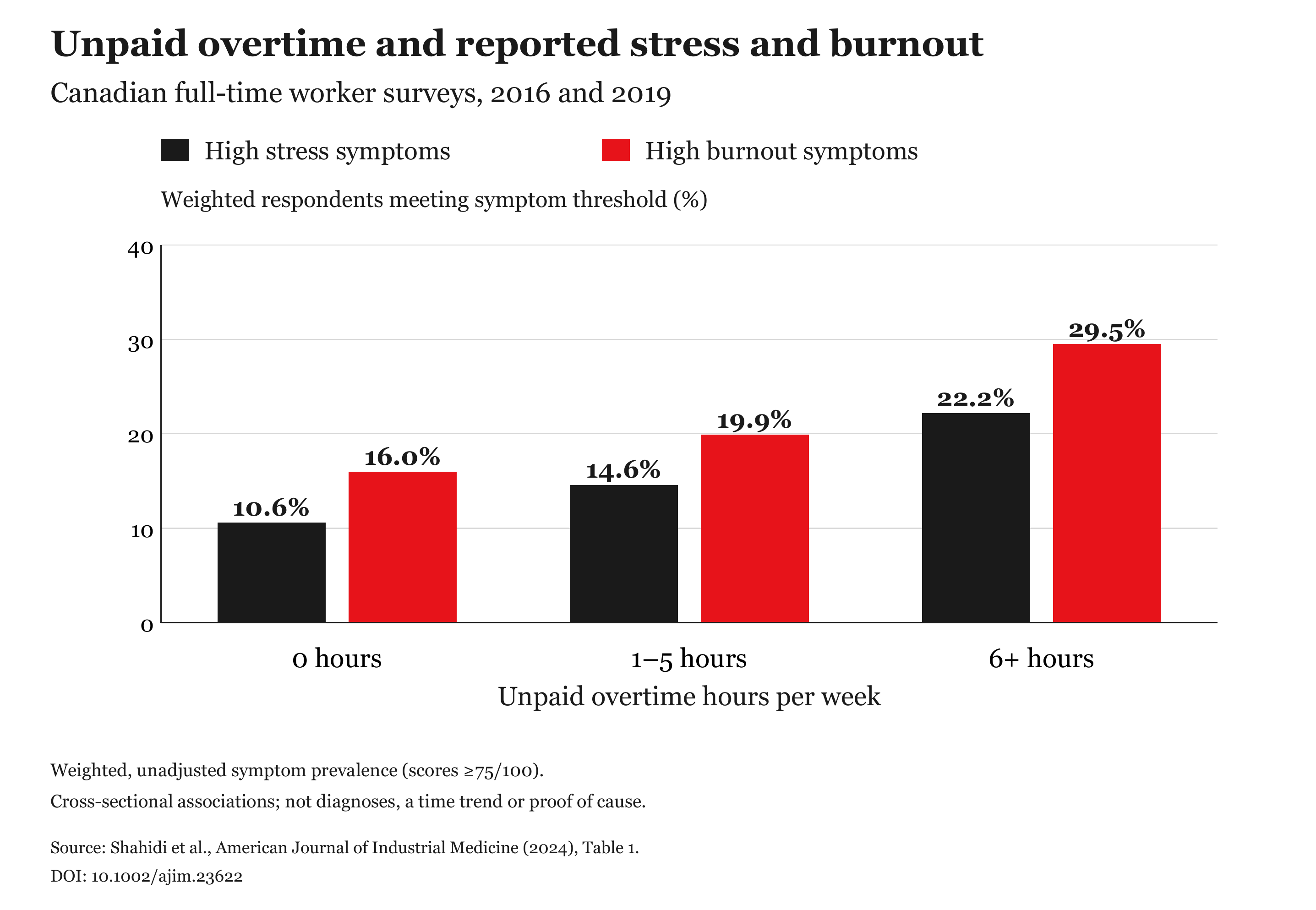
The pattern warrants attention, with limits. The survey response rate was 12 per cent, and the study cannot establish cause. Adjustment for other working conditions weakened some associations. In the most extensively adjusted analysis, excessive unpaid overtime remained associated with stress in men and women, but with burnout in men only.24
Stress, burnout and a diagnosed depressive disorder are different outcomes. A WHO–ILO review judged the evidence insufficient to establish that long working hours cause depression. That finding should remain alongside evidence of other harms.25
There is also evidence of physical harm associated with very long working weeks. The WHO and ILO estimated that exposure to at least 55 hours of work a week contributed to about 745,000 deaths from stroke and ischaemic heart disease worldwide in 2016. This is a modelled global burden for a past year, not a current Canadian death count or a prediction about any one worker. It gives us a reason to question a financial plan that assumes very long hours can continue indefinitely.26

Debt and mental health
Money worries can become a constant source of anxiety even while every payment is being made. Shame about debt may make it harder to describe the problem or ask for help. A financial assessment should give someone room to explain the strain they are under, including what keeping up requires of them.
Employment can provide income without removing financial insecurity. For someone whose obligations already absorb what they earn, an unexpected expense or lost shift can make a tightly balanced budget difficult to maintain.
Toronto Foundation’s 2024 Vital Signs report found that 26 per cent of Toronto adults reported at least moderate depression symptoms in the third quarter of 2024, and 17 per cent at least moderate anxiety symptoms. These are survey screening results, not diagnoses. In a separate comparison pooled across 2021–2024, respondents relying on food programs reported substantially more depression symptoms than those with no financial concern about food. That comparison included only 90 food-program users, so its precise percentages require caution. Both findings concern association, not a demonstrated cause.27
Debt is also associated with mental-health difficulties. A review of 65 papers found associations between unsecured debt and outcomes including mental disorder and depression. A Dutch study followed adults for three years and found that very great difficulty repaying debt was associated with the later onset of a common mental disorder, even after adjustment for several other factors. The study could not account for income at the start because it had not been measured then. Following people over time helps establish the sequence of events, but it does not establish that debt caused the illness. These findings support closer attention to repayment difficulty in discussions of well-being.28
Figure 7: Historical Toronto burnout responses
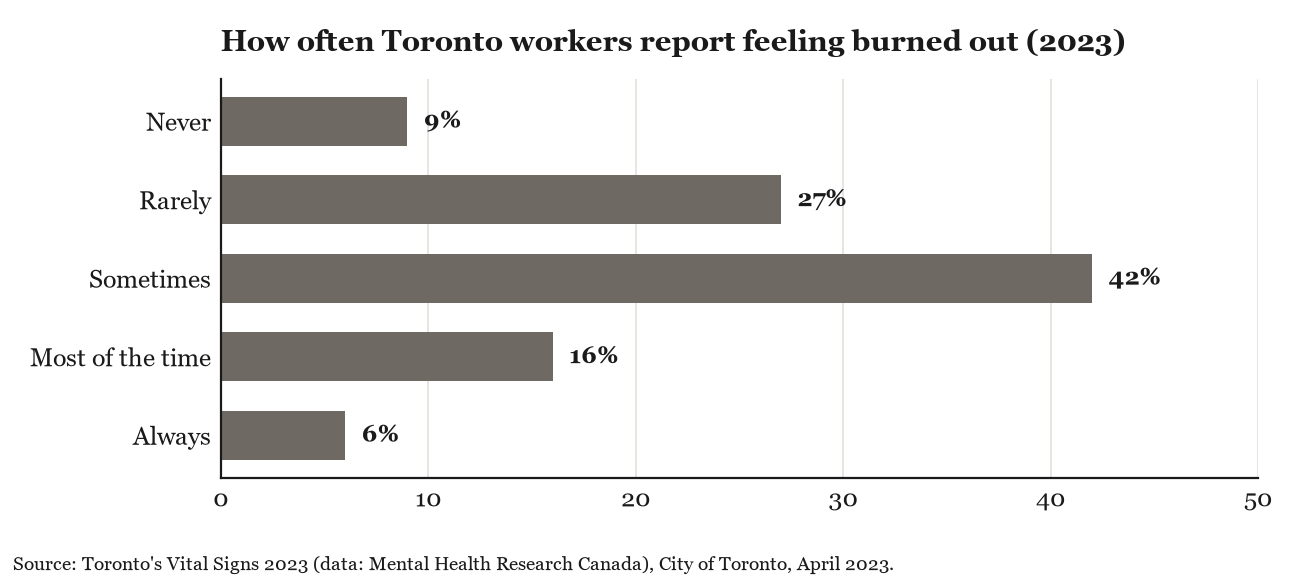
More recent national evidence updates the burnout picture. In Mental Health Research Canada’s 2025 workplace survey, 39 per cent of respondents reported feeling burned out often or always. The online survey included 5,008 employed Canadians and was conducted from 10 to 20 June 2025. This national finding does not attribute burnout specifically to housing or debt. It should not be read as a trend from Toronto-only surveys using different samples and response categories.30
A newer Toronto study offers a closer, though narrower, view. A survey of 265 settlement-sector employees, conducted from November 2024 to January 2025, reported burnout among 41.1 per cent of respondents. It used a convenience sample and a single-item burnout measure. The result describes those participating workers and cannot stand in for a citywide burnout rate. Its findings nevertheless make working conditions and support in an important local service sector worth examining.31
The evidence on social connection
Social connection may appear further removed from insolvency law. It belongs in this discussion because the people describing very long working weeks also describe what those weeks leave out. A fuller account of their circumstances needs to consider the time available for relationships and support as well as the time spent earning income.
The time left outside work matters too. A meta-analysis of 148 studies involving more than 300,000 people associated stronger social relationships with a greater likelihood of survival over the studies’ follow-up periods. That is population evidence, not a personal prognosis. In a financial consultation, it is a reason to take seriously the person who says that keeping up has left no time for the relationships and routines that help them cope.32
Financial and health professionals have different jobs, but their work can complement one another. A trustee can examine debts, assets, income and available options. A health professional can assess symptoms and provide appropriate care. Recognizing financial pressure should encourage access to both forms of help where needed; it should never be used to dismiss health care as merely treating symptoms.
People can seek an initial consultation with a Licensed Insolvency Trustee before missing a payment. The purpose is to understand their circumstances and available options, not to assume that a formal filing is necessary or available. Trustees may advertise free preliminary or initial consultations; it is worth asking about any cost when booking. The practical question is whether the household has a workable plan and whether specialist financial or health support would help.33
A concern that crosses borders
The next step takes us outside Canadian insolvency practice. This comparison warrants space because other countries have experienced housing pressure and financial disruption over different periods, including the years after an asset-price peak. Countries differ in their housing markets, employment systems, health services and debt laws. Their experiences cannot simply be transferred to Canada, but they can help us ask better questions about the pressures described in our own files.
Japan illustrates the economic disruption that can follow an asset-price bubble. The late 1980s bubble was followed by falling asset prices, financial-sector difficulties and prolonged recession. That historical analysis supplies economic context; it does not establish a health effect.34
Figure 8 gives that history a visible scale. The real residential-land index reached 166.3 in the second quarter of 1991 and was 81.5 by the final quarter of 2016, about 51 per cent below the peak. The long decline helps explain why the date of a price peak does not mark the end of its economic consequences. The evidence on health that follows addresses a separate question.
Figure 8: Japan's residential land bubble and long decline
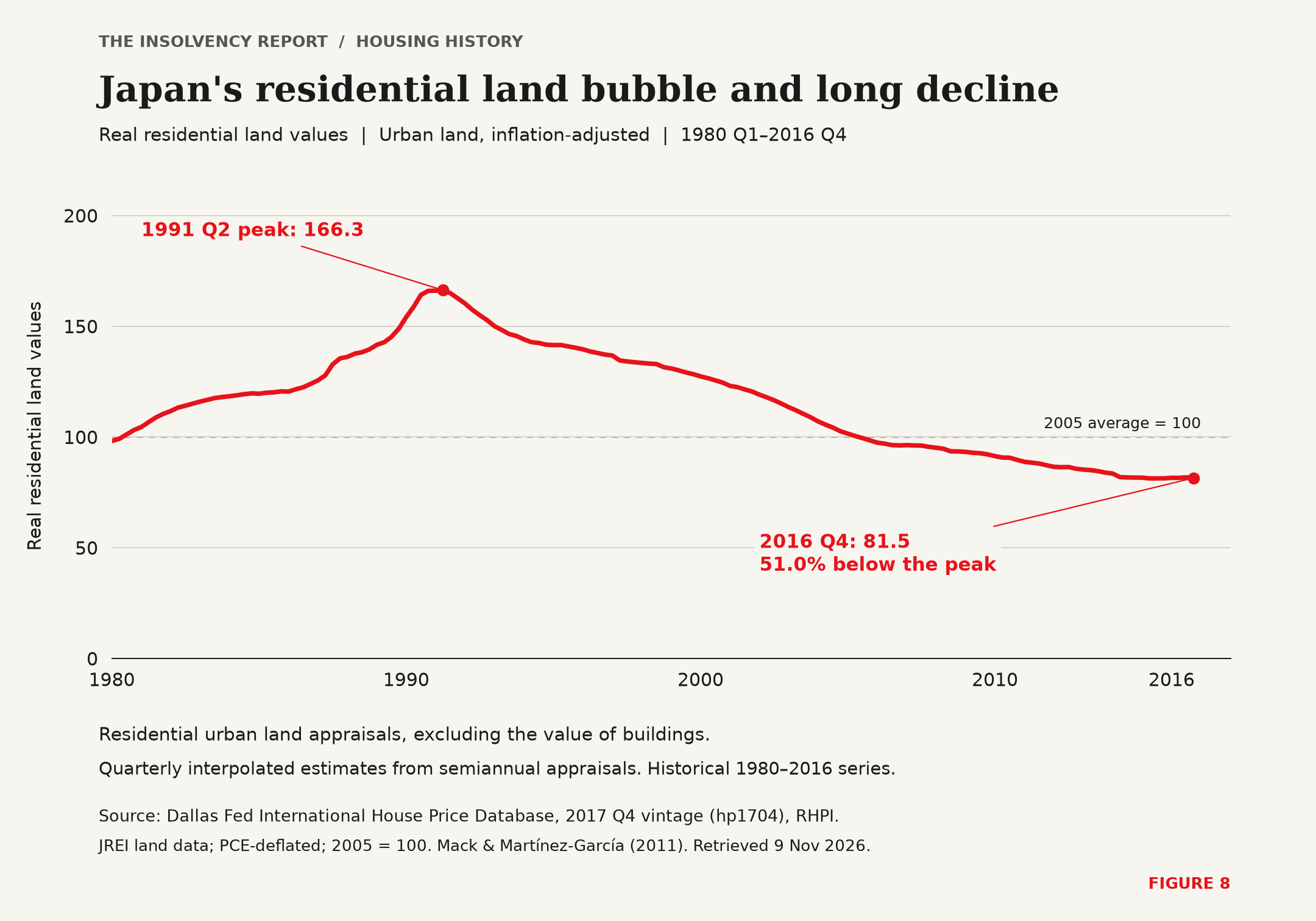
A time-trend study associated the economic crisis of the late 1990s with increased male suicide rates in Japan and some other affected Asian economies. The authors’ institution reported a larger rise among working-age than retired men. A separate Japanese prefectural study associated economic indicators with male suicide mortality, while warning about the limits of population-level findings. Those studies do not isolate housing debt as the cause or explain any individual death. A more recent Japanese study associated a higher mortgage-payment burden with psychological distress, including among higher earners. These are reasons to examine the interaction of financial pressure and health, rather than predictions of Canada’s future.36
South Korea provides a different housing history. Figure 9 shows an earlier price decline, a recovery and a separate recent correction. The real nationwide dwelling-price index fell from 135.9 at its recent peak in the first quarter of 2022 to 114.2 in the second quarter of 2026, a decline of 16.0 per cent. The national price cycle supplies context for the housing pressures studied below; it does not measure the conditions of particular renters in Seoul.
Figure 9: South Korea's national housing-price cycles
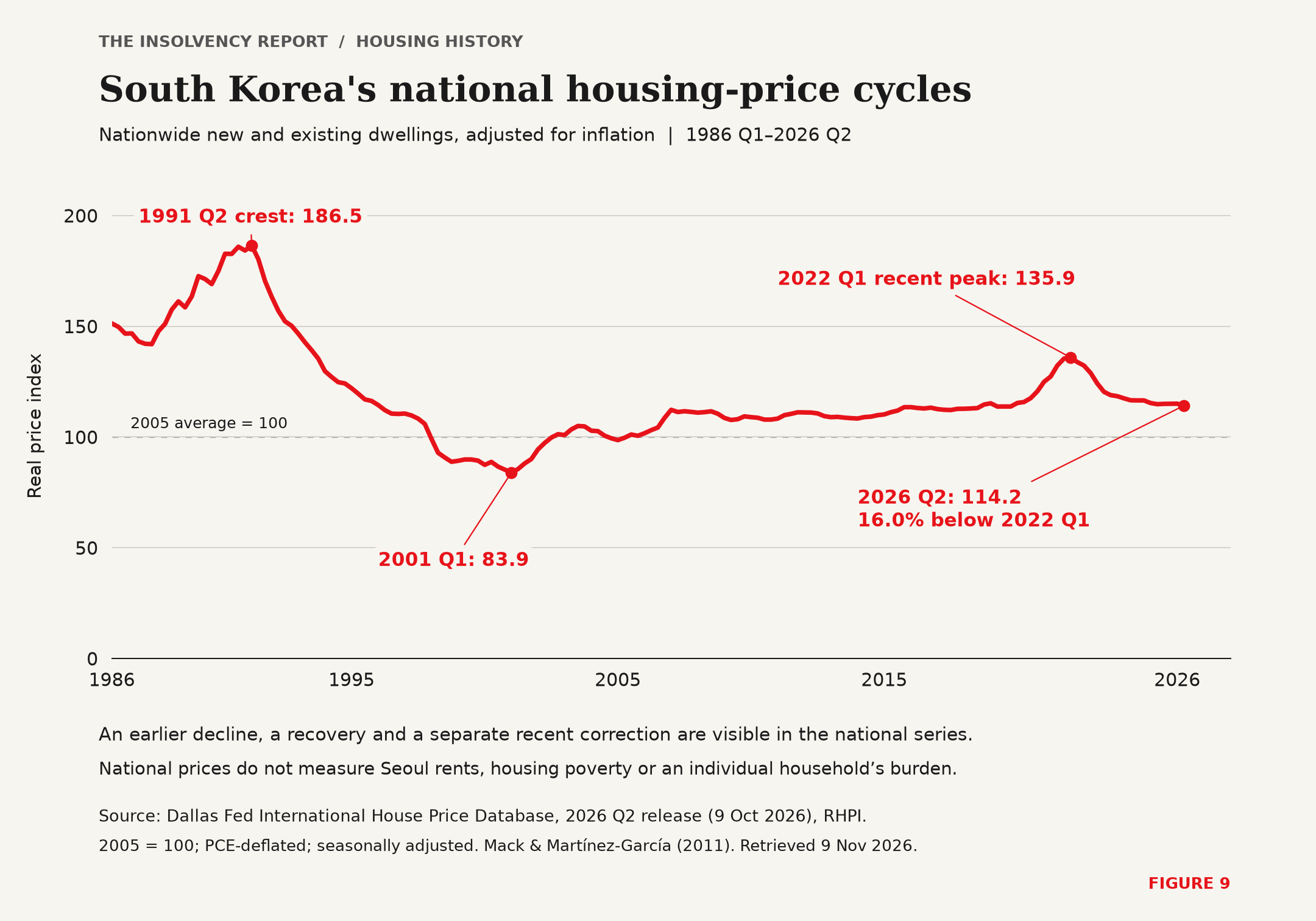
Research from South Korea examines how housing difficulties affect people. Panel research has associated housing-payment difficulties and involuntary moves with depression. Interviews with 44 young adults living alone under housing poverty in one Seoul district described disrupted rest, constrained recovery and reduced social participation. The interviews took place during 2021–2022, under pandemic conditions. The interviews provide insight into experience, rather than a population prevalence estimate. These studies support an international conversation about housing and health without requiring a claim that housing costs alone explain changes in family formation or national fertility.38
A systematic review published in January 2026 brings together 22 studies of housing insecurity and mental health among renters. Six of the nine studies examining affordability reported significant associations between unaffordable housing and poorer mental health; most of those affordability studies focused on low-income renters. Findings were not uniform, and the review combined studies with different designs and measures. Its value is the breadth of evidence that housing insecurity warrants attention, rather than proof that renting itself causes illness.39
Canadian evidence also offers reasons to examine housing interventions directly. A study of people on a Greater Toronto Area social-housing waitlist found improvements in self-rated mental health among those who received social housing, measured over 6 to 18 months. That finding concerns access to social housing. It should not be treated as evidence that a consumer proposal produces the same effect. It does illustrate why research should evaluate practical interventions rather than stop at documenting hardship.40
If you are thinking about suicide or worried about someone you know, Canada’s 9-8-8 Suicide Crisis Helpline is available 24 hours a day. Call 988 or text 988.
From chasing income to a sustainable plan
We can now return to the practical concern with which we began. The wider evidence helps explain why the nurse's account and the man's reliance on overtime deserve attention. The next question is what someone can usefully do with that concern, including when advice may help and what a formal debt solution would require.
The evidence does not establish one explanation for every person who visits a trustee. It does establish that housing, debt and work deserve a place in serious discussions of well-being. My concern is with the financial plan that counts income but takes too little account of what earning it requires. Asking whether that plan can continue is useful before, as well as after, a household falls behind.
Earlier help should begin with an honest review of the options. Depending on the circumstances, that may involve a revised budget, advice from a financial planner who charges for advice rather than product sales, a discussion with creditors, an assessment by a Licensed Insolvency Trustee, or health care. The person should understand the cost and limits of each option. No one should have to interpret exhaustion as a personal failure before asking whether the financial arrangement itself needs to change.
Some longitudinal research has associated leaving over-indebtedness with improvement in depressive symptoms, and reviews have called for closer integration of financial and mental-health support. The evidence reviewed for this article does not establish the mental-health effect of a Canadian consumer proposal. An affordable debt arrangement may remove one source of pressure; it may also involve costs, restrictions and uncertainty that need to be explained. That is a reason to evaluate outcomes carefully, not to market debt relief as treatment.41
If you are helping a friend or family member who is worried about money, begin by asking what help would be useful. Listening without blame, helping organize records or accompanying the person to an appointment may make it easier to seek appropriate advice. Leave decisions about disclosure and the next step with the person concerned.
Stress leave in Ontario and the bills that continue
This practical section goes beyond the original eligibility question because some readers will encounter it only after work and income have already changed. It addresses the financial information a household needs while the leave arrangements are clarified.
For someone taking stress leave in Ontario or elsewhere in Canada, an immediate financial question is what income will be available while they are away from work. The words used to describe the leave do not tell the household how long its bills can be covered. A plan needs confirmed amounts and dates, alongside the expected time away and any uncertainty about returning to work.
If you are asking whether stress leave is paid, or how much you would receive, obtain the applicable terms from your employer, insurer or benefit administrator before counting that money in the budget. The same applies to an application for EI sickness benefits or short-term disability. Confirm the amount, expected start date and any decision still outstanding. An application or expectation should be identified separately from income that has been confirmed.
The length of an approved leave and the time a household can manage on its savings are separate questions. Put together pay records, benefit or insurance terms, account statements and collection notices while the leave arrangements are being clarified. That information can support a discussion of the immediate budget, financial or credit counselling, an assessment by a Licensed Insolvency Trustee and appropriate health care.
Mortgage arrears, a power of sale notice and wage garnishment can add immediate pressure. They raise different questions and should be reviewed against the actual documents. Readers concerned about missed mortgage payments can also consult our guide to falling behind on a mortgage and Ontario power of sale analysis. The consumer proposal discussion below explains one possible route for an eligible person. Taking leave does not, by itself, settle eligibility or which option is workable.
Earlier advice has value even where no formal proceeding follows. The purpose is to understand the debt, the household's actual resources and the choices available before another income interruption narrows those choices. That is the practical meaning of early intervention in this article. It does not require a trustee to predict illness, and it does not turn an income reduction into an automatic entitlement to debt relief.
What is a consumer proposal and where may it help
A consumer proposal is a formal process under the Bankruptcy and Insolvency Act in which an eligible individual offers creditors new terms, which may reduce the debt, extend the time to pay, or both. It is prepared and administered by an administrator, who is a Licensed Insolvency Trustee or another person appointed or designated by the Superintendent of Bankruptcy, and its terms must provide for its performance to be completed within five years. Eligibility includes a debt limit of $250,000, or any other amount prescribed by the General Rules, excluding debts secured by the individual's principal residence. Whether a proposal is suitable depends on the person's circumstances and on a plan they can realistically perform.42
Filing generally stops creditors from starting or continuing proceedings to collect their debts, subject to exceptions in the Act: among others, the stay does not cover support payable under an order or agreement made before the filing, it does not arise for a consumer proposal filed within six months after an earlier one, and a creditor may ask the court to lift it. Filing does not transfer the person's property to a trustee, as bankruptcy does, but it does not remove secured creditors' rights or make mortgage and car payments unnecessary: a secured creditor can generally still enforce its security. Creditor acceptance, approval and performance of the agreed terms matter. Where payments are due monthly or more often, a default equal to three payments causes the proposal to be deemed annulled, unless the court has ordered otherwise or an amendment has already been filed; after that, unless the court orders otherwise, the person cannot make another consumer proposal or have the stay until the filed claims are paid or released. Debts of the kinds listed in section 178(1) of the Act survive unless the proposal expressly compromises them and that creditor votes for it. The amount repaid and the practical consequences need to be explained for the particular case.43
One limit is particularly relevant to a self-employed person with payroll arrears. A consumer proposal does not stay a Canada Revenue Agency enhanced requirement to pay for unremitted source deductions. That issue needs specific advice; it should not be obscured by a general statement that filing stops collection.44
For an eligible person, a proposal may provide a way to align repayment with a realistic budget. It cannot guarantee improved health, preserve an unaffordable lifestyle or establish eligibility merely because a lower workload would be preferable. The value of the assessment is to find out what is legally available and financially workable, while encouraging appropriate health support where it is needed.
Returning to the trustee's question
The opening question remains whether the person seeking help meets the statutory definition and what options the actual circumstances support. The excursions into housing, work, health and other countries explain why that question deserves attention even after the housing-price peak. High costs can persist, and the consequences of commitments made at the peak can emerge later.
The nurse remains important to me because her payment record and the life required to maintain it told different parts of the same story. Trustees already work with difficult individual circumstances. We exercise judgment, explain the available options and accept responsibility for our assessments. The question raised by this article is what happens when the circumstances requiring that judgment become commonplace.
Housing costs are central to the accounts I hear from debtors. When keeping a home depends on sustained overtime, multiple jobs or almost no margin between income and expenses, a later reduction in work can expose financial strain that was already present in the household's way of living. The studies reviewed here give us reason to examine that pattern beyond the individual file, while keeping the legal and health questions distinct.
We should investigate how to recognise that pressure earlier, how existing forms of advice respond to it, and where the framework needs closer examination. A system can record payments being made while missing important information about the conditions under which they are made. Repeated reliance on exceptional professional judgment deserves attention when the same housing and income pressures keep appearing.
If you are worried about money or struggling to sustain your present workload, an assessment can help you understand your financial position and the options available. You can contact Paul Franchi about debt questions and seek appropriate professional care for concerns affecting your health. Seeking advice does not commit you to a filing. Readers who want future research from The Insolvency Report can subscribe through our personal debt resources page.
Appendix: An assessment before choosing a debt solution
An early assessment gives a person a clearer picture of the choices available while there is still time to consider them. The purpose is to examine the debts, assets, income and household expenses together, including the work required to earn that income. The assessment may lead to advice that does not involve an insolvency filing. Where a formal proceeding is available, the choice needs to fit the person's actual circumstances.
A Licensed Insolvency Trustee holds a licence to act as a trustee, issued by the Superintendent of Bankruptcy, whose office is the Office of the Superintendent of Bankruptcy. In a bankruptcy, a licensed trustee is appointed to the particular estate, by the official receiver when a person makes an assignment or by the court when it makes a bankruptcy order; in a consumer proposal, a trustee may act as the administrator. The trustee's assessment should explain the available options and their consequences. A consumer proposal should not be treated as the preferred answer before that work has been done. Bankruptcy may be the more appropriate option in some circumstances, including where a person cannot reasonably perform a proposal. Where the trustee determines that a viable proposal could have been made and the person chooses bankruptcy instead, however, the trustee must say so in the report prepared for the discharge; if the discharge comes before the court and that choice is proved, the court must refuse or suspend the discharge or attach conditions to it. That comparison needs to be explained without treating bankruptcy as a personal failure or assuming that either process will improve someone's health.45
Compare what each option would require
A workable comparison includes the expected payments, the treatment of property, the likely duration, the costs and the responsibilities the person would take on. It also includes the debts that would remain and what would happen if the proposed payments could not be maintained. A lower monthly payment is useful information, but it cannot settle the choice on its own.
The same applies to a homeowner hoping to keep a mortgage current or renew it later. The assessment needs the actual mortgage balance, payments, other secured borrowing and home equity. Keeping the property must be considered alongside the cost of keeping it. Credit reporting and a lender's future decision are separate consequences to discuss, rather than something a debt arrangement can guarantee.
An earlier bankruptcy or proposal, student loans, a joint debt or a guarantee can change the questions that need to be answered. Bring those details to the assessment rather than assuming that all debts receive the same treatment. If wages are being garnished or a creditor has started enforcement, provide the notice and explain any approaching date. The trustee can then explain how the actual debt and proceeding affect the options. Our guides to mortgages and a consumer proposal, credit after a proposal or bankruptcy, a second proposal, and missed proposal payments explain several of these questions in more detail. The others should be addressed in the assessment.
Understand surplus income before relying on a payment estimate
Surplus income in bankruptcy has a specific statutory meaning. It is not simply whatever a person decides is left over after paying their usual bills. The calculation considers income and family circumstances under the Bankruptcy and Insolvency Act and the standards set by the Superintendent of Bankruptcy. Whether payments are required, and what a change in income would mean, should be explained using the person's own information.46
The Superintendent's standards, often described as the surplus income threshold, set the amount the trustee subtracts from the family unit's available monthly income to find the surplus income, and only surplus income at or above a monthly minimum leads to a required payment, generally half of it, subject to adjustments. The standards are set for each year and vary with the number of people in the family unit, so the applicable year and the household information matter. Someone who has used a bankruptcy surplus income calculator should bring the inputs and result to the assessment and ask the trustee to explain any difference. An online estimate cannot settle the treatment of an expense, confirm a discharge date or determine the payment required in a particular bankruptcy.47
A consumer proposal payment is an offer to creditors under its own legal framework. It is not obtained simply by copying a bankruptcy surplus income calculation. The comparison should explain what creditors could receive in bankruptcy and what the proposed arrangement would require of the person making it.
Identify the debts and claims that need individual attention
A proof of claim is the formal document by which a creditor presents its claim in the insolvency proceeding. The amount on a collection letter and the amount accepted in the proceeding are not necessarily the same. A claim may need to be examined, valued or disputed. The person seeking advice should supply account records and any disagreement about the debt so the trustee can explain how the issue would be addressed.
Tax debts need particular care. A deemed trust is a statutory rule that treats money or property as held in trust for a specified claimant, often the Crown. Its operation depends on the debt, the property and the proceeding involved. In a bankruptcy, the Bankruptcy and Insolvency Act does not give effect to most deemed trusts in favour of the Crown, but it preserves those for amounts deducted or withheld for income tax, Canada Pension Plan contributions and Employment Insurance premiums, and certain similar provincial amounts. Other Crown claims generally rank as unsecured claims, subject to listed exceptions. Payroll source deductions, other tax debts and secured claims should not be placed in one undifferentiated category. The source-deduction limit described earlier in this article is one reason to obtain advice on the actual obligation before assuming that filing will stop collection.48
Understand how the proceeding would end
The assessment should explain the conditions for completing a proposal and the discharge process in bankruptcy. A conditional discharge is a court order requiring specified conditions to be met. It should not be confused with an automatic promise that all debts will disappear on a particular date. The nature of the debt and the applicable exceptions matter, as do the person's duties during the proceeding.
These questions are worth addressing while someone can still explain what is happening and gather the necessary records. Bring a realistic account of income, the household budget, property, debts and any expected change in work. The useful outcome is a clear explanation of what can be done, what each choice would require and which questions remain unresolved. That gives the person a basis for deciding before another financial event makes the decision more urgent.
Written and built by a Licensed Insolvency Trustee with a legal and finance background and a co-author with scientific training. No fees for advice. A bankruptcy or consumer proposal does involve fees, which the Bankruptcy and Insolvency Act and its rules govern. No referrals for sale. The light is on.49
Paul Franchi, JD, MBA, CIRP, LIT—Founder, The Insolvency Report, and Dana Trentini, HBSc, BEd, MA, EdM. insolvencyreport.ca
About the authors
Dana Trentini graduated with High Distinction in neuroscience from the University of Toronto and holds a counselling degree from Teachers College, Columbia University. She brings a scientific research background to this article. The first-person voice, from the trustee's desk, is Paul's; his contribution is grounded in his work as a Licensed Insolvency Trustee. Fuller author biographies close the piece.
Paul Franchi, JD, MBA, CIRP, LIT, is a Licensed Insolvency Trustee. A former practising lawyer, he brings seventeen years of Wall Street experience in investment management, product development and finance to his insolvency work. He is the publisher and editor-in-chief of The Insolvency Report.
Dana Trentini, HBSc, BEd, MA, EdM, graduated with High Distinction from the University of Toronto with an Honours Bachelor of Science in Neuroscience, where she received multiple academic scholarships, including the Stanley Kosta Todorow Scholarship for academic excellence in the life and physical sciences. She holds a Bachelor of Education from Western University, an M.A. in Organizational Psychology from Columbia University and an Ed.M. in Counseling Psychology from Teachers College, Columbia University, where she served as team leader on a professor's research team. She has worked as a talent management and leadership development consultant to JPMorgan Chase in New York, and she founded a digital health platform that grew to more than one million social media followers and was featured in The Wall Street Journal and The Atlantic.
Neither author practises medicine, and nothing in this article is a diagnosis or a substitute for professional health care; the health research above is evidence about populations, not advice about any individual case.
This article is for general information and does not constitute legal, financial or medical advice.
Sources
These notes identify the sources and dates used for this full reading edition.
- 1.Bankruptcy and Insolvency Act, R.S.C. 1985, c. B-3, s. 2, definition of “insolvent person”; Justice Laws Website, consolidated Act current to 19 October 2026, last amended 20 June 2026; exact definition checked 9 November 2026, https://laws-lois.justice.gc.ca/eng/acts/B-3/section-2.html .
- 2.Bankruptcy and Insolvency Act, s. 2, definition of insolvent person, paragraphs (a) and (c); s. 66.11, definition of consumer debtor; and s. 66.12(1).
- 3.Bankruptcy and Insolvency Act, s. 2, definition of insolvent person, paragraph (a); Kormos v. Fast, 2019 ONCA 430, paras 14 and 15; Roderick J. Wood, Bankruptcy and Insolvency Law, 2nd ed., pp. 19 to 21.
- 4.German Insolvency Code (Insolvenzordnung), ss. 18(1) and (2), 304(1) and (2) and 305(1); official German text at gesetze-im-internet.de, with an English translation (not binding) by Ute Reusch on the same site.
- 5.Federal Reserve Bank of Dallas, International House Price Database, release hp2602, second quarter 2026, published 9 October 2026; source workbook retrieved 8 November 2026.
- 6.Federal Reserve Bank of Dallas International House Price Database, release hp2602, 9 October 2026.
- 7.OECD Analytical House Price Indicators, price-to-income series, data retrieved 15 July 2026; OECD Economic Surveys: Canada 2025, “Improving housing affordability,” May 2025, p. 54.
- 8.OECD Analytical House Price Indicators, data retrieved 15 July 2026.
- 9.CCPA, “Making Rent: The CCPA’s rental wage update 2024”; Government of Ontario, “Ontario Protecting Workers by Raising Minimum Wage,” 1 October 2026, https://news.ontario.ca/en/release/1008075/ontario_protecting_workers_by_raising_minimum_wage (rate checked 7 November 2026).
- 10.Toronto Regional Real Estate Board, GTA Rental Market Report Q1 2026; data retrieved 15 July 2026.
- 11.CMHC, Rental Market Report 2025, national overview and Canada Table 5.0, https://eppd1strscr01.blob.core.windows.net/cmhcprdcontainer/sf/project/archive/housing_markets/rentalmarketreportcanadaandselectedmarkets/rental-market-report-2025-fall-en.pdf; national overview checked 8 November 2026.
- 12.CMHC, Residential Mortgage Industry Report, Fall 2026 Edition, “At a Glance” and “Mortgage borrower stress is rising unevenly,” https://www.cmhc-schl.gc.ca/professionals/housing-markets-data-and-research/housing-research/research-reports/housing-finance/residential-mortgage-industry-report; checked 8 November 2026.
- 13.Bank of Canada, Canadian Survey of Consumer Expectations, Third Quarter of 2026, 19 October 2026, https://www.bankofcanada.ca/2026/10/canadian-survey-of-consumer-expectations-third-quarter-of-2026/ . Financial-health and spending sections read 8 November 2026. Online survey 5-27 August 2026; follow-up interviews 24 August-4 September. Chart-level data and other special-topic sections were not independently audited.
- 14.Singh, Daniel, Baker and Bentley, American Journal of Preventive Medicine 57(2): 262 (2019); Mason et al., Social Science & Medicine 94: 91 (2013); Baker et al., Social Psychiatry and Psychiatric Epidemiology 55(6): 715 (2020); Mason et al., Social Science & Medicine 351: 116939 (2024); primary abstracts or source records checked 8 November 2026.
- 15.Statistics Canada, Table 36-10-0124-01, dated series through 2026-Q1.
- 16.Statistics Canada, "National balance sheet and financial flow accounts, second quarter 2026," 11 September 2026, https://www150.statcan.gc.ca/n1/daily-quotidien/260911/dq260911a-eng.htm; Bank of Canada, Financial Stability Report 2026, "Households," https://www.bankofcanada.ca/publications/financial-stability-report/financial-stability-report-2026/households/ (article bodies checked 7 November 2026).
- 17.Statistics Canada, Table 11-10-0065-01, September 2026 vintage. The table gives the 2023-Q1 peak as 15.17 per cent; The Daily reports 15.16. The body uses about 15.2 per cent. These national aggregates do not describe each household.
- 18.Mental Health Research Canada, Poll 29, published 22 September 2026, n = 4,005, methods and question A3A, p. 25, https://www.mhrc.ca/s/Poll29_22092026_LongVersion_FINAL.pdf; full report checked 8 November 2026.
- 19.Mental Health Research Canada, Poll 29, question A3A, p. 25; methods p. 3. Fielded 27 July to 10 August 2026, 4,005 adults, weighted by gender, age and region. Negative impact means a rating of 0 to 3 on a 0-to-10 scale; the chart shows three of the five pressures asked about. Original chart by The Insolvency Report using the published percentages; source PDF and plotted values independently checked on 8 November 2026. https://www.mhrc.ca/s/Poll29_22092026_LongVersion_FINAL.pdf
- 20.Toronto Foundation, Toronto’s Vital Signs 2023; historical report.
- 21.Statistics Canada, Table 14-10-0049-01, Multiple jobholders by usual hours worked at all jobs, annual 2025 data released 9 January 2026, https://www150.statcan.gc.ca/t1/tbl1/en/tv.action?pid=1410004901 . Canada excluding the territories, population aged 15 and older; 474.4 / 1,178.6 and 64.7 / 1,178.6 thousand, respectively. Source table and calculation checked 9 November 2026.
- 22.Statistics Canada, Table 14-10-0031-01, Usual hours worked by job type (main or all jobs), annual 2019 and 2025 data, https://www150.statcan.gc.ca/t1/tbl1/en/tv.action?pid=1410003101 . Canada excluding the territories, population aged 15 and older; 1,719.6 / 19,070.8 and 1,601.1 / 21,028.7 thousand, respectively. Same usual-hours definition in both years; calculations checked 9 November 2026.
- 23.Shahidi et al., “Unpaid overtime and mental health in the Canadian working population,” American Journal of Industrial Medicine 67(8): 741–752 (2024), Table 1 and methods, https://onlinelibrary.wiley.com/doi/full/10.1002/ajim.23622 . Original chart using the six published weighted percentages; Table 1 checked 9 November 2026. The methods and table report 4,056 observations, while the abstract reports 3,691; the chart does not resolve that discrepancy by selecting an overall sample count.
- 24.Shahidi et al. (2024), methods, results and limitations, https://onlinelibrary.wiley.com/doi/full/10.1002/ajim.23622 . The six chart values are unadjusted weighted prevalence, not the adjusted estimates; the supplementary results are described in the main article, while the separate supplementary file was unavailable in this review.
- 25.Rugulies et al., Environment International 155: 106629 (2021), https://pubmed.ncbi.nlm.nih.gov/34144478/ ; primary abstract and conclusion checked 8 November 2026.
- 26.WHO and ILO, “Long working hours increasing deaths from heart disease and stroke,” 17 May 2021, https://www.who.int/news/item/17-05-2021-long-working-hours-increasing-deaths-from-heart-disease-and-stroke-who-ilo; Pega et al., Environment International 154: 106595 (2021).
- 27.Toronto Foundation, Toronto’s Vital Signs 2024, Health, findings and endnotes viii–ix, https://torontofoundation.ca/vital-signs-2024-health/; question, sample, period and screening measures checked 8 November 2026. The food-program comparison reports 62 per cent versus 12.5 per cent; it is not a 2024-only estimate.
- 28.Richardson, Elliott and Roberts, Clinical Psychology Review 33(8): 1148–1162 (2013), https://doi.org/10.1016/j.cpr.2013.08.009, abstract checked; Ten Have et al., Administration and Policy in Mental Health 48(5): 810–820 (2021), https://doi.org/10.1007/s10488-021-01131-9, Scite-indexed main text read in full, 8 November 2026; supplementary material not reviewed.
- 29.Toronto Foundation, Toronto’s Vital Signs 2023; data provided by Mental Health Research Canada.
- 30.Mental Health Research Canada, Workplace Mental Health 2025, methods p. 2 and burnout chart p. 40, https://www.mhrc.ca/s/Workplace-Mental-Health-2025.pdf; checked 7–8 November 2026.
- 31.CMHA Toronto and Toronto South Local Immigration Partnership, Exploring Workplace Stress, July 2025, printed pp. 3, 5, 7 and 16, https://torontolip.com/wp-content/uploads/2025/07/Final-CMHA-TSLIP-Research-Brief-July-2025.pdf; methods, results and limitations checked 8 November 2026.
- 32.Holt-Lunstad, Smith and Layton, “Social Relationships and Mortality Risk: A Meta-analytic Review,” PLoS Medicine 7(7): e1000316 (2010).
- 33.OSB Directive No. 33, Trustee Designation and Advertising, para 13; OSB Directive No. 6R7, Assessment of an Individual Debtor, paras 2, 11 and 15.
- 34.Okina, Shirakawa and Shiratsuka, Bank of Japan Monetary and Economic Studies 19(S-1): 395–450 (2001), abstract and relevant introduction checked 8 November 2026, https://www.imes.boj.or.jp/research/papers/english/me19-s1-14.pdf .
- 35.Federal Reserve Bank of Dallas, International House Price Database, historical 2017-Q4 vintage, RHPI, based on Japan Real Estate Institute residential urban land data; Mack and Martínez-García (2011), https://www.dallasfed.org/~/media/documents/research/international/houseprice/hp1704.xlsx . Inflation adjustment uses the personal-consumption-expenditure deflator. The historical vintage precedes the later switch to detached-house transactions. Series ends in 2016 to exclude terminal-vintage nowcasts and interpolation uncertainty; no current-market claim. Method: https://www.dallasfed.org/~/media/documents/research/international/houseprice/japan.pdf . Source, plotted values and calculation checked 9 November 2026.
- 36.Chang et al., Social Science & Medicine 68(7): 1322–1331 (2009), https://doi.org/10.1016/j.socscimed.2009.01.010, primary abstract and author-institution account checked, full paper not available in this review; Aihara and Iki, Journal of Epidemiology 13(1): 56–61 (2003), https://doi.org/10.2188/jea.13.56, indexed methods, results and limitations read; Ogawa et al., Preventive Medicine Reports 50: 102987 (2025), indexed main text read. Checks completed 8 November 2026.
- 37.Federal Reserve Bank of Dallas, International House Price Database, 2026-Q2 release, published 9 October 2026, RHPI; Mack and Martínez-García (2011), https://www.dallasfed.org/~/media/documents/research/international/houseprice/hp2602.xlsx . Nationwide dwelling index from 1986, with earlier construction-cost proxies excluded; personal-consumption-expenditure deflator. Method: https://www.dallasfed.org/~/media/documents/research/international/houseprice/korea.pdf . Source, plotted values and calculation checked 9 November 2026. Japan's land series and Korea's dwelling series describe different objects; the common index base does not make absolute prices comparable.
- 38.Park and Seo, International Journal of Environmental Research and Public Health 17(19): 7125 (2020); Lee and Yoo, Health Promotion International 40(6): daaf231 (2025), https://doi.org/10.1093/heapro/daaf231; indexed main text read through its end, with the author and publication record checked against the publisher-deposited article, https://pmc.ncbi.nlm.nih.gov/articles/PMC12744942/ .
- 39.Talmatzky et al., “Exploring the association between housing insecurity and mental health among renters,” PLoS ONE 21(1): e0294222 (2026), https://doi.org/10.1371/journal.pone.0294222; discussion and study table checked 8 November 2026.
- 40.Dunn et al., “Does receipt of social housing impact mental health?”, Social Science & Medicine 362: 117363 (2024), https://doi.org/10.1016/j.socscimed.2024.117363; primary abstract and publisher highlights checked 8 November 2026. This was a quasi-experimental study, not a randomized consumer-debt intervention.
- 41.Hojman, Miranda and Ruiz-Tagle, “Debt trajectories and mental health,” Social Science & Medicine 167: 54–62 (2016), https://doi.org/10.1016/j.socscimed.2016.08.027, primary abstract and publisher highlights checked 8 November 2026; Ten Have et al., https://doi.org/10.1007/s10488-021-01131-9; Turunen and Hiilamo, BMC Public Health 14: 489 (2014), review.
- 42.Bankruptcy and Insolvency Act, s. 2, definitions of proposal, prescribed and Superintendent; s. 66.11, definitions of administrator and consumer debtor; ss. 66.12(5), 66.13(1) and (2)(c) and 66.14(a)(ii); OSB Directive 6R7, para 16; Bankruptcy and Insolvency General Rules, C.R.C., c. 368, current to 19 October 2026, which prescribe no other amount for s. 66.11.
- 43.Bankruptcy and Insolvency Act, ss. 66.28(2) and (2.1), 66.31(1), 66.32(1), 69.2(1), (2) and (4), 69.4, 69.41(1), 71 and 121(4).
- 44.Income Tax Act, s. 224(1.2), which is made subject to Bankruptcy and Insolvency Act ss. 69(1) and 69.1(1) but not to the consumer proposal stay in s. 69.2; see also Bankruptcy and Insolvency Act, s. 69.5, for similar provincial measures. Both Acts as consolidated on the Justice Laws Website, current to 19 October 2026.
- 45.Bankruptcy and Insolvency Act, ss. 2, 13(1) and (2), 43(9), 49(4), 66.11, 172(2) and 173(1)(n); OSB Directive 6R7, paras 16 and 19.
- 46.Bankruptcy and Insolvency Act, s. 68(1), (2) and (3); OSB Directive 11R2-2026, Surplus Income.
- 47.OSB Directive 11R2-2026, para 5(5), (6) and (7); Bankruptcy and Insolvency Act, s. 68. Standards are for the applicable year and family unit; no personal payment is calculated here.
- 48.Bankruptcy and Insolvency Act, s. 67(2) and (3), and s. 86(1) and (3); Income Tax Act, s. 224(1.2). The deemed-trust explanation here concerns bankruptcy; the consumer-proposal source-deduction collection limit is separately explained above.
- 49.OSB Directive 33, paras 1 and 11 to 13; Bankruptcy and Insolvency Act, ss. 39(1), 66.12(6)(b), 156, 156.1 and 157.1(1); Bankruptcy and Insolvency General Rules, rules 128, 129, 131 and 132.