Mortgage trouble · New research
A condo purchaser’s nightmare, revisited: closing, default and the cost of ownership
The risks I described in January 2024 now confront households before closing, after a failed purchase and after taking ownership. Each situation calls for a different decision, based on the obligations and monthly costs the household can actually carry.

Industry Alert
The risks I described in January 2024 now confront households before closing, after a failed purchase and after taking ownership. Each situation calls for a different decision, based on the obligations and monthly costs the household can actually carry.
Paul Franchi, JD, MBA, CIRP, LIT, Founder
September 2026. The market evidence below identifies its reporting period. The purchase-contract discussion focuses on Ontario; the Bankruptcy and Insolvency Act is federal.
1. The aftermath of the closing risk
The reckoning I warned about in January 2024 is here. My central analysis was right: for some pre-construction purchasers, a falling property market would become an insolvency dilemma when the obligation to close came due.
I coauthored that article with Jeremy Kroll, CPA, CA, CIRP, LIT, of Baigel Corp., Licensed Insolvency Trustees. We looked beyond falling condominium prices to the obligations purchasers would still have to meet. A lower appraisal would not reduce the contract price. Finding enough money to close could leave a household carrying debts it could not sustain. Failing to close could expose the purchaser to a developer’s claim beyond the deposit already paid.
That article has aged well. The consequences I examined are now part of the work coming through my door as a Licensed Insolvency Trustee. This report takes the analysis forward: what can the household do now, and how can its advisers recognize the right next step?
Much of that responsibility falls first to mortgage brokers. They are often the people who must deliver the unwelcome news that the expected financing is unavailable or that substantially more cash will be required. They must then recognize when the difficulty extends beyond financing and when advice from a lawyer or an LIT may be valuable.
Not every purchaser facing a loss is insolvent. Some can absorb the loss, negotiate an exit or pursue another workable course. Others face an insolvency dilemma. Knowing when to seek an LIT assessment matters.
This report is written with mortgage brokers in mind. It distinguishes three situations.
- Before Closing: Funding Pressure
Before closing, the purchaser cannot find enough money to complete, or can do so only by taking on commitments the household may not be able to carry. The purchase has not yet failed. Funding the closing and affording life after it are separate questions.
- Failed Closing: Developer’s Claim
After a failed closing, the purchaser has not completed, is in default and faces a developer’s demand or lawsuit. The household needs legal advice on the contractual claim and a clear picture of the resources available to respond. A demand or lawsuit is not a judgment establishing the amount owed.
- After Closing: Ownership Costs
After completing the purchase, the owner has the property but is overleveraged or cannot sustain its carrying costs. The immediate problem is the mortgage and household budget, rather than a developer’s claim for failure to complete that purchase.
These are different situations, not three stages every purchaser passes through. For the same contract, completion and failed completion are alternative outcomes. A household with several properties may face more than one problem at once.
In each situation, the household needs to understand its financial commitments before choosing a course. The mortgage broker reviews financing and discusses affordability with the client. Counsel advises on the agreement, the claim and the legal alternatives. Where financial distress warrants it, a Licensed Insolvency Trustee (LIT) conducts an individual financial assessment. Those roles contribute different information and advice; the broker is not being asked to conduct the LIT’s assessment.
The aim is a course the household can perform. Another loan, a negotiated exit or a formal insolvency process is useful only when it addresses the situation the household actually faces.
It forms part of Insolvency Report’s Mortgage Trouble centre, which brings together guides on missed payments, renewal difficulties, selling with debt and checking a lender’s bill. The centre also provides practical resources for mortgage brokers to help organize the facts and prepare the next conversation.
I am particularly grateful to Canadian Mortgage Professional (CMP) for recognizing the importance of this issue and keeping its readers informed as these problems unfold.
2. The market around the contract
I use Toronto-area condominium data to illustrate the market change confronting purchasers who committed to pre-construction contracts years earlier. This is one of Canada’s largest condominium markets, with a well-documented history and direct relevance to the Ontario circumstances discussed here. Comparable pressures have also been documented in Vancouver, although their timing and severity differ. CMHC, June 10, 2025.
The two panels show quarterly resale prices and new-condominium sales from 2015 to June 2026. Resale prices show the changing market for completed units. The sales chart counts new condominiums sold by developers, including units already completed. In Q2 2026, only 50 of the 702 new-condominium sales were pre-construction purchases. The broader total therefore gives only part of the picture facing the pre-construction market. The dotted marker in the price panel locates the January 2024 article. The shaded gap in the sales panel identifies Urbanation’s change in geographic coverage.
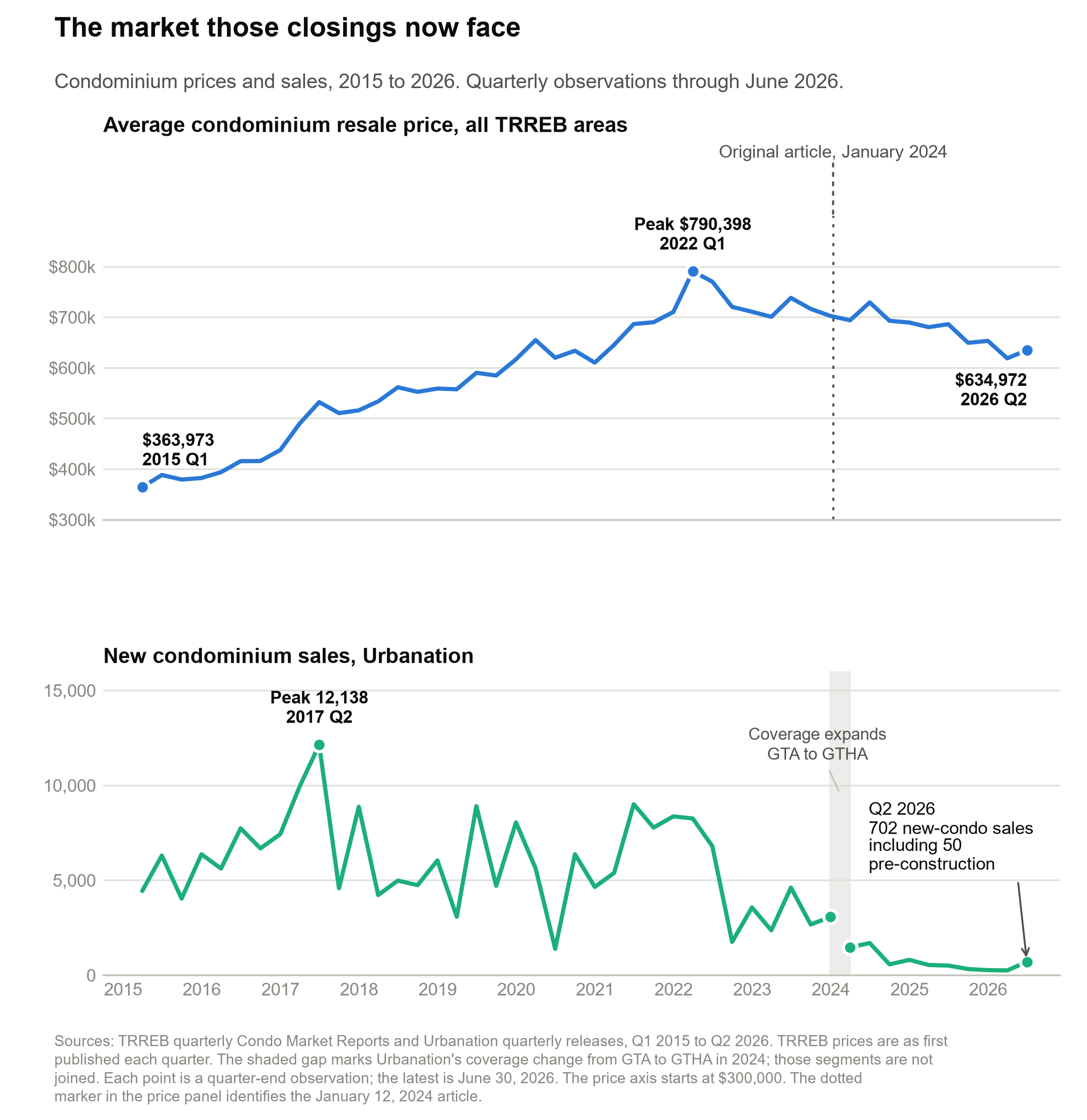
Sources: TRREB quarterly condo reports and Urbanation. Each point is a quarter, placed at quarter-end; the latest is June 30, 2026. Urbanation’s geography changes from the GTA to the Greater Toronto and Hamilton Area (GTHA) in 2024. The shaded gap marks that boundary; the earlier and later counts are not joined because they are not a like-for-like series. The price axis starts at $300,000. Full methods appear at the end.
By Q2 2026, the average resale condo price across the Toronto Regional Real Estate Board’s (TRREB) area was $634,972, down 17.5% from Q2 2022. This regional average helps show how the market changed after earlier contracts were signed. An individual purchaser still needs a current valuation of the particular unit.
Urbanation reported that the 702 new-condominium sales in Q2 2026 were 86% below the ten-year average for that quarter. Of those sales, 535 were in completed projects, including bulk purchases. Sales of completed units accounted for nearly all the improvement over the previous year, while pre-construction sales fell. The increase in the broader total therefore did not signal a recovery in pre-construction demand. These figures do not measure assignment sales. Urbanation, July 20, 2026.
Urbanation also reported that resale condos in recently registered GTHA buildings averaged $859 per square foot in Q1 2026, 25% below their Q1 2022 peak. That narrower measure helps explain the pressure on recent purchases, but it is neither the chart’s average resale price nor an appraisal of an individual contract. Urbanation, April 16, 2026.
Before closing, lower values can reduce the available mortgage advance while weak demand limits a hoped-for exit. After default, the developer’s resale result may matter to the claim its lawyer advances. After completion, the owner has to fund the property while considering whether and when to sell. None of these regional measures determines the value of a particular unit or the result of a particular legal claim.
For the household, the next questions are therefore practical. If the expected sale does not happen, how much cash is needed and how long can it keep paying? My LIT assessment of Daniel’s circumstances illustrates why the closing requirement and the monthly carrying cost must be considered separately.
3. Before closing: an LIT assessment of the commitments
Before Closing: Funding Pressure
Before closing, an LIT assessment can help a purchaser in financial distress compare the commitments ahead with the alternatives available. Daniel’s circumstances illustrate my work as the LIT conducting that assessment before his scheduled closings. It is not an account of a completed portfolio’s actual losses.
When I refer to an assessment in this article, I mean the individual financial assessment conducted by a Licensed Insolvency Trustee under the Office of the Superintendent of Bankruptcy’s Directive No. 6R7, Assessment of an Individual Debtor. The LIT considers the person’s financial circumstances, including assets, debts, income, expenses and the causes of the financial difficulty, and explains the available options and their consequences, including alternatives to a proposal or bankruptcy. The purpose is to help the person understand the choices and determine whether an insolvency proceeding is appropriate. It is not a commitment to file.
This work is worth explaining to mortgage brokers because it helps them understand what happens when a client seeks an LIT’s advice. Knowing the questions an LIT considers can inform the broker’s earlier discussion, the documents gathered and whether the client may benefit from a referral. It does not ask the broker to perform the LIT’s assessment or predict a filing outcome.
This account is shared with permission. Daniel is a pseudonym, and identifying personal and transaction details have been changed. The financial figures illustrate the projections considered during my LIT assessment.
Daniel came to see me shortly before his fiftieth birthday. He worked in sales of ophthalmology products and earned about $150,000 a year. He owned a home and held retirement savings. He was inexperienced in pre-construction condominium purchases. He had signed agreements to purchase four units. One had sold early in the process for a $40,000 gain, leaving three purchases to work through. He had expected to keep only one property as a long-term investment.
The approaching closings required me to consider the remaining purchases together. I projected the cash needed at each closing and the monthly costs afterward, making assumptions about timing, mortgage financing, rents and resale values. That work helped him understand what he might need to borrow, what he would have to contribute from income or savings, and which alternatives he should explore. These were scenarios prepared to help him decide what to do.
In one projected month, two rental properties required $8,381 in carrying payments. That comprised $6,610 in mortgage payments, $450 in property taxes, $1,021 in condominium fees and $300 in insurance. Their expected rents totalled $4,750, leaving $3,631 that would have to come from elsewhere each month. The calculation showed what carrying those two properties could require under the assumptions I used.
There was a separate cash requirement at closing. One purchase had a price of $779,000 and a deposit of $155,800, leaving a purchase balance of $623,200. The forecast assumed a property value of $616,000 and a mortgage advance of 80% of that value, or $492,800. On those assumptions, another $130,400 would be needed before closing costs. That demand had to be considered alongside the future carrying payments and his other financial commitments.
Daniel was shocked by what the projections showed when the purchases were considered together. After allowing for financing and carrying costs, and losses on properties he expected to have to sell to fund the remaining closings, the forecast showed a net loss of more than $500,000 across the four purchases. That projected loss exceeded the equity he held in his principal residence.
These were forward-looking estimates based on the assumptions I was examining. Changes in property values, financing and the outcome of the purchase contracts could make the eventual result better or worse. The outlook was bleak. It also had to be distinguished from his financial position at the time of my assessment: the projected losses had not yet occurred.
Daniel was dismayed at the advice he believed he had received from the realtors involved. He also told me that a mortgage broker had provided financing approvals for the purchases even though he had never met or spoken by phone with that broker. These were his accounts of the circumstances that brought him to seek help.
A proposal is a formal offer to settle debts under Canada’s Bankruptcy and Insolvency Act. It is made to creditors, the people or organizations owed money, and administered by an LIT. Whether it is available depends on the person’s circumstances, beginning with the LIT’s determination of whether the person is insolvent.
My conclusion as the assessing LIT was that Daniel did not meet the insolvency test. I declined to file a proposal. On the information he provided, I considered that he had reasonable grounds to investigate a claim against his realtor, and he chose to pursue legal recourse. He also obtained a release from one of the purchase contracts. The appropriate course in his circumstances was to pursue the available alternatives to a proposal or bankruptcy.
My LIT assessment considered those future commitments alongside Daniel’s wider finances. That work helped him understand his choices and led to a recommendation to pursue legal recourse and alternatives to an insolvency filing.
The two figures answer different questions. The $130,400 was the additional cash required for one projected closing before costs. The $3,631 was a projected monthly contribution for two rental properties under the selected assumptions. Finding the first sum would not explain how the second would be paid month after month. Neither figure, by itself, established that Daniel was insolvent.
Daniel had expected to retain only one property as a long-term investment. Other purchasers intended to live in the home they were buying and may have no rent or other property. An LIT assessing their circumstances would use their own housing costs, income and commitments. The following financing illustration isolates the appraisal problem; it is separate from Daniel’s case.

Editorial illustration created for this report. It does not depict a specific development.
4. Before closing: what financing or an exit would require
Before Closing: Funding Pressure
Lower interest rates help with payments, but they do not supply the missing purchase money.
The Bank of Canada held its policy rate at 2.25% on September 2, 2026. Its statement described a rebound in housing activity after several weak quarters. That national observation does not establish the value or financeability of a particular condo. Bank of Canada.
What happens to the cash needed at closing
Consider a purchaser who agreed to pay $750,000, paid a $75,000 deposit and allowed $10,000 for closing costs. Those are the assumptions I used in the January 2024 article, repeated here so this comparison stands on its own. In each scenario below, assume the lender advances 80% of the appraised value.
| Item | Original plan, January 2022 | Original 2024 scenario | Illustrative 2026 scenario |
|---|---|---|---|
| Contract price | $750,000 | $750,000 | $750,000 |
| Assumed closing costs | $10,000 | $10,000 | $10,000 |
| Deposit already paid | $75,000 | $75,000 | $75,000 |
| Value used for the illustration | $750,000 | $675,000 | $640,000 |
| First mortgage | $600,000 | $540,000 | $512,000 |
| Cash still needed at closing | $85,000 | $145,000 | $173,000 |
| Additional cash above the original plan | None | $60,000 | $88,000 |
The calculation is purchase price plus costs, less the deposit and first mortgage. The $640,000 value is an assumption, not an appraisal or an estimate derived from the chart. It is about 14.7% below the contract price. The $10,000 cost allowance is carried from the original example for comparison; an actual statement of adjustments, taxes and legal costs must replace it on a real file.
The purchaser who had saved the expected $85,000 must now find another $88,000. A reduction in the interest rate does not reduce that gap.
There is a counterintuitive payment result as well. The original $600,000 mortgage at 2.74% cost $2,441.35 monthly over 30 years. At an illustrative 4.24%, the smaller $512,000 mortgage costs $2,504.67. The first-mortgage payment is only about $63 higher, while the additional closing cash is $88,000.
The apparently manageable payment describes a much smaller loan. It leaves the missing money out of the monthly comparison.
Ratehub displayed 4.24% on its five-year fixed page when read on September 20, with the table stamped September 18, 2026. Its page identifies that figure as a high-ratio rate. It is used here only to illustrate the arithmetic, not as a rate available for this uninsured, 30-year scenario or for an investment property. Monthly payments use semi-annual compounding and 360 monthly payments. Ratehub.
What a private second mortgage has to accomplish
If another lender offers the missing money, the broker’s financing discussion with the client continues. The broker can explain the amount actually advanced after charges, the monthly cost, the principal due at maturity and the proposed source of repayment. The client needs to see how those obligations fit the household budget.
A hypothetical private mortgage makes the distinction concrete. Assume a one-year, interest-only loan of $350,000 at 10%, with $44,500 of lender, broker and legal charges deducted at advance. The borrower receives $305,500. A year of interest is $35,000, bringing fees and interest to $79,500, about 26% of the cash received. That is a simple first-year cost comparison, not an annual percentage rate or a claim about typical lending terms. The $350,000 principal still has to be repaid.
Private financing can serve a temporary need. This example does not show that any particular loan is unsuitable. It shows why an approval and a quoted rate are insufficient to decide whether the loan improves the file.
If the repayment plan depends on a higher appraisal next year, say so. If carrying the property still requires money from the household every month, include that amount. The family needs to see what it is committing to after the immediate closing problem has been funded.
The separate guide Power of Sale in Ontario: What It Means When a Private Lender Comes After Your Home addresses the mortgage-enforcement problem. It should not be confused with the developer’s claim under an uncompleted purchase agreement.
An assignment sale needs more than a buyer
The agreement of purchase and sale is referred to below as the APS. “Vendor” means the contracting seller; this report uses the term for the relevant developer or builder.
An assignment is the sale of the purchaser’s contract, not of the unit: the original purchaser transfers their rights under the APS to a new purchaser, who closes in their place.
A useful file review asks whether there is a buyer who can close, what net result the transaction produces, and what the vendor has agreed to in writing. An asking price in an assignment advertisement cannot answer those questions. Neither can Urbanation’s count of new pre-construction sales.
For the purchaser, the key distinction is that an assignment transfers the purchaser’s rights, it does not release the purchaser’s obligations. Unless the vendor expressly releases the original purchaser, or agrees to a novation that puts the assignee in the original purchaser’s place under a new contract, the original purchaser remains liable on the APS, including for the vendor’s losses if the assignee fails to close. The Supreme Court of Canada has stated the rule plainly: contractual benefits may be assigned to a third party, contractual obligations may not, and a novation requires the assent of the party owed the obligation, which a court will not find without an express agreement unless the circumstances are compelling (National Trust Co. v. Mead, [1990] 2 S.C.R. 410).
Establish the contractual options before choosing a course
Ask the real estate lawyer to examine the agreement, amendments, notices, delivery records, deposit receipts and any proposed release. The questions include whether the purchaser must complete, whether a statutory or contractual remedy is available, and what exposure remains.
A lawyer reviewing the agreement of purchase and sale will look beyond the matters a layperson or a Licensed Insolvency Trustee may consider. The review can include the agreement’s date and terms, the disclosure statement and condominium guide, when documents were delivered, amendments or material changes, and notices exchanged with the developer. Counsel can advise whether those facts support a remedy or affect the obligation to close. My role as the LIT is to assess the purchaser’s financial position and available options alongside that advice.
The purchaser needs to compare documented possibilities, including financing the household can carry, an assignment with its remaining obligations understood, or another resolution counsel considers available. The fact that closing looks unaffordable does not answer what happens if it fails. That is the next, distinct situation.
5. After a failed closing: understand the developer’s claim
Failed Closing: Developer’s Claim
Here the purchaser has not completed the purchase and faces the consequences of default. The work is no longer simply to fill a closing gap. The legal file must establish what the developer is claiming, what the purchaser disputes and where the matter stands.
In July 2026, The Globe and Mail reported that its review of court filings had found two dozen lawsuits across five Metro Vancouver presale projects. Developers were seeking judgments against individual purchasers for amounts from $70,000 to $166,000. Those are claims, not amounts the court had awarded, and the count describes those B.C. projects, not the rate of failed closings in Ontario. Globe and Mail, July 23, updated July 24, 2026.
In my Ontario practice, the developer’s threatened claim is increasingly part of the first conversation. That is a practice observation, not a market census. The purchaser needs to understand the claim, but I also need to understand the household receiving it.
A demand asks the purchaser to pay. A lawsuit brings the claim before a court. The purchaser may contest liability, the amount, or both; a judgment is a different stage. Advisers should identify which documents have actually arrived and give them to counsel, rather than describe every claimed amount as an established debt. The household’s resources matter alongside the merits of the dispute: a possible defence or recovery is of little practical comfort without a discussion with counsel about the costs and resources needed to pursue it.
Fergal McAlinden’s August 21, 2026 reporting for CMP described brokers helping presale purchasers facing lost deposits and developer lawsuits, including first-time buyers who intended to own a home. Vancouver broker Lev Keselman described an appraisal discussion as “a hopeless discussion” when the gap was too large to bridge. His account also described the work of supporting clients and connecting them with lawyers. Canadian Mortgage Professional.
These accounts concern people facing the loss of deposits and claims against them, including people who intended to buy a home. They should not be read as evidence that every troubled purchaser was an investor or that every claim succeeds.
The deposit is not a liability limit
The governing rule for damages on breach of contract, virtually universal across common law jurisdictions, is that the aggrieved party is entitled to damages that put it in the position it would have occupied had the breach not happened. The vendor can resell the unit and still pursue the purchaser for the full extent of its damages, including the shortfall if the resale price is below the original APS, and on a favourable judgment it can pursue the purchaser’s assets and sources of income through seizure of assets and wage garnishment.
In plain terms: in Ontario, the deposit is not the ceiling of what a purchaser who fails to close can lose. In most cases it is the floor.
Can the purchaser recover a forfeited deposit?
In hindsight, the discussion of deposit recovery in the first article understated how important the issue would become in practice. When I wrote that article, I raised the possibility that a purchaser might have a claim for the return of some or all of a lost deposit, and that a supportable claim might need to be recorded as an asset. The deposit-recovery passage referred to Pleterski, 2023 ONSC 5546.
One of the two lawyers who reviewed the article found the position interesting and uncommon in the context of a failed purchase. I also remember the patience of the reference librarian who helped me work through difficult authorities and their subsequent treatment.
The question has since become much more than theoretical in my conversations with purchasers in financial distress. Many believe that the developer should return their deposit. Their reasons vary, but a practical difficulty recurs. By the time they meet with me, they may have neither the resources nor the appetite for an expensive legal fight. They feel that they have fought as long as they can and are now throwing in the towel.
That belief deserves to be heard and investigated. The documents and the applicable law still have to support a claim, and any possible recovery has to be considered with its uncertainty and cost in view. Recording a potential claim is not a promise that the money will be recovered.
This brings the issue back to my work as a Licensed Insolvency Trustee. Form 79, the Statement of Affairs, is the document that sets out the debtor’s assets, liabilities and other financial information in an insolvency proceeding. A possible claim to recover a deposit raises practical questions: is there a supportable recovery right, how should it be described, and what value, if any, can reasonably be assigned to it? An entry does not establish that the developer owes the money or that it will be collected. My task as the LIT is to assess and record the debtor’s financial affairs; the legal merits of pursuing the claim require advice from counsel.
Three decisions illustrate why the question deserves legal advice. In Azzarello v. Shawqi, 2019 ONCA 820, the Court of Appeal confirmed the ordinary rule that a purchaser who repudiates the agreement can lose the deposit without the vendor proving a loss. In Scicluna v. Solstice Two Limited, 2018 ONCA 176, the court granted relief from forfeiture. In Ching v. Pier 27 Toronto Inc., 2021 ONCA 551, relief was refused and that refusal was upheld on appeal.
These cases show that recovery arguments have been considered by the courts; the question is more than a theoretical possibility. They also show that relief is not automatic. Whether a purchaser has a supportable claim, what it might recover and what it would cost to pursue are questions for counsel on the particular facts. For an LIT, the practical task is to identify the possible asset and account for its uncertainty, rather than assume either that the deposit is recoverable or that the question ends when it is forfeited.
The LIT’s assessment must accommodate uncertainty in both directions: a developer’s claim against the purchaser, and any supportable claim the purchaser may have. Section 9 explains how those issues can be addressed within a proposal when the purchaser qualifies. First, consider the household whose purchase did complete. Its immediate financial problem is different.
6. After completion: can the household keep carrying the property?
After Closing: Ownership Costs
For this owner, the closing money has been found and the purchase is complete. There is no failed closing on that contract to resolve. There may instead be a mortgage payment the household struggles to meet, a private loan approaching maturity, or a continuing drain on income and savings. Completing the purchase has answered how to acquire the property; it has not necessarily answered how to afford it.
The broker’s discussion with a client who has completed should start with what is now happening each month. For a rental property, compare the rent actually received with mortgage payments, taxes, condominium fees, insurance and the other costs the owner must pay. For a home the purchaser occupies, compare those payments with household income and ordinary living expenses. For an owner-occupied home with no rental income, there is no rent to offset those costs. In either case, include the other debts and properties that draw on the same paycheque or savings.
Daniel’s forecast illustrates why this matters, without establishing what happened to him after my LIT assessment. In the scenario described earlier, two rentals would require a contribution of $3,631 a month. For an owner actually making a comparable contribution, the question is where next month’s money comes from and what continued payment leaves for the household’s other needs. An answer that depends on repeated new borrowing needs to include the cost and repayment of that borrowing too.
Compare continued ownership with an exit
The broker can help the owner compare the financing and cash-flow requirements of the available courses. To keep the property, show the monthly contribution, its source, any loan coming due and the assumptions needed for the arrangement to remain workable. To refinance, show the net advance, all charges, the new payment and how principal will be repaid. The private-mortgage illustration in section 4 applies to that calculation as well: access to cash is only the beginning of the financing discussion.
To discuss a possible sale, the broker and client need a supportable sale estimate alongside mortgage balances, selling costs and other amounts to be settled. Establish whether the sale would leave money for the owner or a shortfall requiring further advice. A hoped-for future price cannot be treated as the price available today. If a lender is pursuing mortgage enforcement, that is a mortgage file requiring its own advice, not the developer-default analysis in section 5.
A lower property value and an unaffordable monthly payment also need to be distinguished. An owner may be able to carry a property worth less than the debt against it; another may have equity but lack enough income to meet payments. If the owner seeks an LIT’s advice, both the cash-flow problem and the asset-and-debt position belong in the LIT’s assessment. Neither an investment loss nor a monthly property deficit alone determines whether a formal insolvency process is available.
Where the difficulty extends across the household, the LIT assessment in section 7 and the mortgage discussion in section 10 become relevant. A proposal does not guarantee that the owner can retain a property or continue funding its deficit. If giving up the property is under consideration, raise that with the LIT during the assessment: the timing and treatment of any mortgage shortfall need to be addressed before a proposal is drafted.
What waiting requires
I take the cost of waiting seriously partly because I have watched property markets turn before.
In 1991, as an articling student at Fogler, Rubinoff in Toronto, I watched a busy real estate practice grow quiet. Years later, while working in investment management in the United States, I saw homes in Phoenix and Atlanta stripped of copper, properties offered around $180,000 after carrying mortgages around $380,000, and streets with many homes for sale. These are my recollections of what I saw, not a statistical comparison with Canada today.
The lesson I bring to a purchaser’s file is limited and practical. A view about where a market will eventually go needs to be tested against how long this household can keep paying. I cannot promise when its property will recover. I can ask what another year of waiting requires.
Continued ownership may be affordable. It may also consume the money needed for the rest of the household while the owner waits for a recovery whose date is unknown. The broker’s discussion should make that cost visible, so keeping, refinancing or disposing of the property is considered on its actual consequences. The same discipline applies before closing, but the completed owner is now making a decision about a property and debt already in place.
7. What the LIT examines in the household assessment
When a person in any of the three situations comes to an LIT, the assessment has no predetermined filing outcome. The LIT needs to establish whether the person can meet their obligations and explain the options that fit the whole financial position.
A bad investment is not, by itself, an insolvency. The proposals and the bankruptcy described below exist for a person who is insolvent under the Bankruptcy and Insolvency Act (BIA): in plain terms, someone who cannot pay their debts as they come due, or who owes more than they own. That is not a formality. It is a threshold the LIT must examine in the required individual assessment.
The ability to assemble closing funds does not settle that question if the resulting obligations cannot be carried. Nor does an investment loss establish insolvency if the purchaser can absorb it. My LIT assessment of Daniel is a useful reminder: he came for help with serious financial decisions, did not meet the insolvency test, and was advised to pursue alternatives.
Arranging one’s affairs to look insolvent when one is not is the worst thing a purchaser can do. The Act lets a trustee reverse payments and transfers made before a filing, a bankrupt can be examined under oath, and a discharge from bankruptcy can be opposed on exactly those facts. A trustee is bound by a professional code not to assist anyone down that road.
In my work as the assessing LIT, I begin with the person’s whole financial position. I need to know who owns each asset, who owes each debt and who has guaranteed another person’s borrowing. That includes the home, other properties, unsecured balances, income and living expenses.
Before Closing: Funding Pressure. I examine the cash and future commitments required by each purchase.
Failed Closing: Developer’s Claim. I consider the developer’s demand alongside counsel’s advice about it.
After Closing: Ownership Costs. I examine the actual property costs, mortgage obligations and any proposed sale or refinancing.
These are parts of my LIT assessment. I cannot understand the condo’s effect on the person without considering the other obligations drawing on the same resources.
For the broker, the value of understanding this process is practical. A discussion about available financing may reveal that the difficulty extends beyond the requested loan. Accurate documents and a clear account of the client’s concerns make a later meeting with an LIT more useful. The broker can help the client prepare for that meeting; the LIT remains responsible for the individual assessment and for explaining the insolvency options and alternatives.
The initial meeting with an LIT is explained in What Really Happens When You Meet a Licensed Insolvency Trustee in Canada?. For the wider range of mortgage difficulties, the Mortgage Trouble centre provides the related guides.
When a proposal is an option
Where the LIT’s assessment identifies a proposal as an option, the process has to fit the person’s circumstances. Consumer proposals and Division 1 proposals are two forms of that process, with different rules and risks.
The Consumer Proposal Resource Centre explains the first process, and Division 1 Proposals in Plain Terms explains the second. The next section sets out their different requirements. Section 9 then returns specifically to the purchaser facing an unresolved developer claim; section 10 addresses ownership and secured mortgage obligations.
8. Which proposal process applies?
The BIA offers two Proposal streams, and each mechanic below is anchored to its governing section. For an individual whose aggregate debts, excluding debts secured by the individual’s principal residence, do not exceed $250,000 (the ceiling in force as of September 2026; a regulation proposed in Canada Gazette Part I on November 29, 2025 would raise it to $325,000, but it is not in force and by its own terms would take effect a year after registration), the Proposal is a Consumer Proposal under Division II (BIA s. 66.11, “consumer debtor”).
The exclusion for debts secured by a principal residence is an important part of that ceiling. A homeowner with a $600,000 mortgage on their home and $90,000 of consumer debt is inside the $250,000 ceiling, not outside it, which matters directly to pre-construction purchasers who already own a home; a mortgage on any other property counts in full.
A consumer proposal must complete performance within five years (s. 66.12(5)), and its acceptance and approval rules include the following: if creditors holding 25 per cent of proven claims do not demand a meeting within 45 days it is deemed accepted (s. 66.18(1)), if a meeting is called but lacks quorum it is deemed accepted (s. 66.18(2)), and if no one seeks court review within 15 days of acceptance it is deemed approved by the court (s. 66.22(2)). This is the statutory backing for the streamlined design the 2024 article described.
For an insolvent purchaser who does not qualify for a consumer proposal, the other proposal stream is Division I. The LIT must explain that option’s risks and alternatives as part of the individual assessment. That stream carries mandatory creditor voting at a higher acceptance threshold, an actual court approval hearing, automatic bankruptcy if the Proposal is refused or rejected (the insolvent person is deemed to have made an assignment: BIA ss. 57(a), 61(2)(a)), and sometimes security for the Proposal payments.
Its offsetting benefit is speed at the front: a Notice of Intention to Make a Proposal can be filed quickly (s. 50.4(1)) and triggers a stay of proceedings (s. 69(1)), giving 30 days (s. 50.4(8)), extensible by court application in increments of up to 45 days to a maximum of five further months (s. 50.4(9)), to craft and file the Proposal.
Either stream is designed to produce certainty as to timing, cost, and quantum, and neither is a bankruptcy, which usually shortens the debtor’s path to rebuilding a credit score.
The administrator’s statutory opinion is that the Proposal is “reasonable and fair to the consumer debtor and the creditors” (s. 66.14(a)(ii)), professionally specified by CAIRP Standard of Professional Practice No. 08, not the discharge-conduct provision at s. 173(1)(a) with which the “more than a bankruptcy” idea is sometimes mis-anchored.
The fuller explanation of the second route is Division 1 Proposals in Plain Terms. For a comparison of the alternatives, see Consumer proposal versus bankruptcy, worked line by line.
The repayment plan also has to be one the debtor can carry. (A consumer proposal is deemed annulled by operation of law once the debtor is in default by the equivalent of three payments, unless an amendment has already been filed or the court has ordered otherwise, s. 66.31(1), which the trustee should explain up front so the debtor understands the payment discipline the instrument requires.)
That is another reason to show any continuing property deficit before a proposal is designed. A lower unsecured payment does not supply rent that the property is not earning or income that an owner-occupier does not have. The general cost explanation is How a consumer proposal payment is calculated.
9. An unresolved developer claim within a proposal
Failed Closing: Developer’s Claim
This section returns to failed completion. The purchaser is facing a developer’s claim under an uncompleted agreement, and an LIT’s assessment has identified a proposal as an option. These claim mechanics should not be mistaken for a way to change the secured mortgage on a completed purchase; that distinction follows in section 10.
Protection under the BIA gives a purchaser rights when debts exceed the ability to repay. Canadian law lets an honest but unfortunate debtor make a Proposal to creditors, which is a negotiated repayment plan, or assign into bankruptcy; both are formal processes conducted through a Licensed Insolvency Trustee. A Proposal can be as creative as the circumstances require and can include the debt to the developer even when the exact amount is not yet fixed. The developer is often the largest creditor, which generally gives it the greatest voting weight, so it helps to select a trustee who knows pre-construction shortfall cases.
A Proposal covers all of a debtor’s liabilities as of the filing date, including debts not yet crystallized. A vendor threatening or already commencing suit, whose claim has not been determined, holds a contingent claim; a claim that cannot be fixed by simple arithmetic and may not crystallize for months or years is an unliquidated claim. Both are provable and can be specifically included in a Proposal under BIA s. 121(2). For a purchaser facing an unresolved developer claim, this is an important mechanism: it lets a purchaser draw an uncertain, litigation-bound developer claim within the proposal process rather than leaving it to run for years as a source of cost, stress, and deteriorating mental and financial health.
The trustee is not a passive recipient of the developer’s number. Under BIA s. 135 the trustee is empowered to value, or to disallow, a contingent or unliquidated claim. The creditor may dispute the valuation, and there is a mechanism for judicial review; some trustees, or the courts on appeal, may require the creditor to establish quantum in a separate proceeding. The caveat for a professional reader is that a valuation decision by any court officer, whether trustee, registrar, associate judge, or judge, is subject to appeal up the chain, so even a well-intentioned effort to expedite can be drawn out if a creditor presses. The purpose is to address the amount of the claim earlier in the process, rather than leave it unresolved through years of ordinary civil litigation.
This is the part of the analysis that the family needs to understand after receiving a large demand. The trustee values the claim within a process that also accounts for the other debts. The creditor can challenge the valuation. A quick or uncontested outcome is not promised.
Why a claim against the developer may also appear
An important part of my work on a failed-purchase file is to identify both a potential liability and any supportable claim for recovery. In limited and appropriate circumstances, my practice is to list both a liability and an asset in the Proposal documents. It can seem incongruous to record, in the same filing, a debt owed to the developer and a claim owed by the developer. But where the debt to the developer is contingent and any recovery from the deposit or other developer-caused damages is not yet known, listing both keeps both scenarios visible to every stakeholder at once. It also has a threshold consequence that can decide which stream the purchaser uses: listing the developer’s claim as contingent, valued under s. 135, may bring the debtor’s total listed debts below the $250,000 ceiling and allow a Consumer Proposal under Division II rather than a Division I Proposal, with all the streamlining that entails. In some files the Proposal format and the trustee’s actions drive a negotiated settlement without the delay and expense of litigation.
Read that possible recovery together with section 5. Relief from forfeiture remains exceptional, and the asset is a claim to recover money, not an assumption that the deposit will be refunded. Neither an asserted recovery nor a disputed liability should be treated as a convenient number chosen to obtain a preferred result.
For the general framework, see the Consumer Proposal Resource Centre. The distinctive issue here is the unresolved developer claim and any legally supportable claim in the other direction.
10. Ownership, mortgage obligations and the proposal
The family home belongs in the LIT’s assessment in all three situations. It may be the purchaser’s existing home alongside an uncompleted purchase, or the property bought through the completed transaction. Ownership, the lender’s security and the ability to afford the payments are separate questions. An investment property’s mortgage must also be identified separately; section 8 explains the principal-residence distinction in the consumer-proposal debt ceiling.
In an ordinary consumer proposal, the debtor keeps ownership of the home, subject to the proposal’s terms. The mortgage lender retains its security, and the debtor must keep meeting the mortgage obligations.
The Bankruptcy and Insolvency Act bars a lender from terminating or amending the mortgage, or calling the loan, by reason only that the borrower is insolvent or has filed a proposal. It does not cure arrears, excuse a default on any other ground, or require the lender to advance more money.
Where a client intends to give up the property, the shortfall after the sale may become an unsecured debt, and whether the proposal covers it depends on the timing and on what the proposal says. That is why a surrender should be raised before the proposal is drafted, not after.
Equity matters in both proceedings, but differently. In a proposal, expected bankruptcy realization helps inform the offer and the consideration of fairness. Filing does not transfer the house to the administrator.
In bankruptcy, the trustee must deal with the debtor’s non-exempt interest, subject to the mortgage and applicable exemptions. Sometimes that involves a sale; sometimes a family member funds the acquisition of the estate’s interest.
Keeping title and keeping the property affordable are separate questions. A proposal can address unsecured debt. It cannot make rent cover expenses or guarantee a higher selling price.
The detailed mortgage questions belong in Mortgages and a Consumer Proposal: Renewing, Refinancing, and Buying a Home. The credit consequences are explained in Your credit after a consumer proposal or bankruptcy: R7, R9, and the honest answers.
Those distinctions should be part of the family’s comparison before it chooses a course. Keeping ownership, meeting the secured payments and funding the household’s other needs all have to be considered.
11. What the broker can do at the next conversation
Begin by establishing where the purchase stands. Is closing still ahead, has it failed, or does the client now own the property? If several purchases are involved, record the status of each. That short inquiry determines which documents and decisions matter next.
The broker can then assemble six sets of facts for the client’s financing discussion and, where relevant, for counsel’s advice or an LIT assessment.
- Transaction status and dates. Before closing, record the closing date, extensions and notices. After failed completion, collect the demand, claim and any judgment or other legal documents. After completion, record mortgage maturity dates, payment difficulties and lender notices.
- Value and financing. For an uncompleted purchase, obtain the contract price, current appraisal, written financing terms and cash still required. For a completed property, obtain current loan balances and terms, and the value being used to consider refinancing or a sale.
- Cash flow and repayment. Identify the source of any new cash, the full property costs, household income and living expenses, and how any new loan will be repaid. Separate actual payments from forecasts and expected rent from rent received.
- The legal documents. Assemble the agreement and amendments, assignment consent, proposed release or negotiated exit for counsel. On a completed purchase, include the mortgage and any proposed sale or surrender in the discussion.
- The deposit record, where relevant. Obtain deposit receipts and the disclosure documents with their delivery history for counsel’s review.
- The wider household. List the other debts, assets, monthly commitments, co-borrowers and guarantees, with ownership and liability identified.
The documents need to reflect the client’s current position. An old pre-approval, remembered property value or expected family contribution should not stand in for the information needed to make today’s decision. The aim is to give the broker, lawyer and LIT reliable facts for their respective work, without confusing their roles.
A broker may not recruit someone to file. The Bankruptcy and Insolvency Act makes it an offence for any person, not only a trustee, to solicit or canvass someone, directly or indirectly, to make a proposal or an assignment in bankruptcy (s. 202(1)(f)), and a trustee may neither pay nor accept any payment or other benefit for a referral (Code of Ethics for Trustees, Rule 49), so nothing of value passes in either direction. So the useful sentence, when a purchaser asks for a loan the adviser knows cannot be placed, is not “you should file”. It is that what they have is no longer a lending problem, and that the person who can tell them what it is, is a trustee. Then the household decides.
A broker does not need to promise a legal or insolvency outcome to be useful. A well-documented concern, legal advice where needed and an LIT assessment where appropriate can move the conversation forward when another financing application cannot.
Resources from Insolvency Report
The Broker Closing-Risk Toolkit accompanies For mortgage brokers: when a client’s problem stops being a lending problem. It brings together a six-question triage, a closing-risk file sheet, a private-mortgage cost worksheet and downloadable template letters in PDF and editable Word formats.
- Six-question triage
- Closing-risk file sheet (Word)
- Private-mortgage cost worksheet (Word)
- Template letters, PDF and Word (Word)
Open the Broker Closing-Risk Toolkit
Obtain your own internal compliance department’s approval before using these resources professionally.
These resources are provided by Insolvency Report. They support fact gathering and professional conversations; they do not replace advice on the purchaser’s circumstances. The resource page identifies the files available.
12. The decision after the warning
The risks I described in January 2024 concerned what an earlier purchase commitment could require of a household in a changed market. The aftermath cannot be addressed with a single instruction to borrow, wait, default, sell or file a proposal. It depends first on where that purchase now stands.
Before Closing: Funding Pressure. For the purchaser before closing, the decision is whether completion can be both funded and sustained, and what alternatives are legally and financially available if it cannot. A loan that meets the closing date still has to fit the months that follow.
Failed Closing: Developer’s Claim. For the purchaser after a failed closing, the decision begins with counsel’s advice on the developer’s claim and a clear picture of the household’s ability to respond, including an LIT assessment where financial distress warrants it. A demand is not the final determination of liability. Contesting it, negotiating a resolution and considering an insolvency process each require attention to the legal position, resources, costs and the person’s other debts.
After Closing: Ownership Costs. For the owner after completing the purchase, the decision concerns a property already owned and obligations already being carried. Continued ownership, refinancing and an exit must be compared using actual payments, available income and the consequences of each course. Dealing with other debts does not, by itself, make the property affordable.
The broker’s financing discussion, counsel’s advice and any LIT assessment should together leave the household able to answer four concrete questions: how much cash is needed now, what obligations remain, what must be paid each month, and what has to happen for the proposed course to work? Uncertain claims and hoped-for market improvements should remain visible as uncertainties.
My LIT assessment of Daniel led to alternatives to a proposal or bankruptcy. Another household may be able to carry its property; another may need an insolvency process. The shared lesson is to connect the contractual position to the whole household’s capacity before another commitment is made. A family facing the loss of its savings or home deserves a plan it can perform, with its risks explained and its circumstances treated with respect.
Sources and method
This report follows the January 12, 2024 article I co-authored with Jeremy Kroll. It examines the decisions households face before closing, after a failed purchase and after taking ownership.
Daniel’s account is shared with permission and with identifying personal and transaction details changed. Its figures are selected forward-looking projections, not actual losses, a reconstruction of every original transaction or a measure of a typical purchaser’s position. My personal history and Ontario practice comments are recollections and observations, not measures of market prevalence. The private-mortgage example is hypothetical. The closing table is an illustration based on the original’s assumptions, with the later appraisal explicitly assumed.
The chart covers all 46 quarters from Q1 2015 to Q2 2026. Resale prices are the averages published in TRREB’s quarterly condominium reports across all TRREB areas. Each observation uses the figure first published for that quarter; later reports may revise earlier figures. The price comparison uses Q2 2022 and Q2 2026.
Urbanation’s new-condominium sales series covers the GTA through 2023 and the Greater Toronto and Hamilton Area from 2024. A shaded gap separates the line segments where that coverage changes. Each observation is placed at quarter-end, with June 30, 2026 as the latest date. The January 12, 2024 marker in the price panel identifies publication of the earlier article. It is not a price or sales observation.
The distinction between new sales and pre-construction sales, and the comparison with the ten-year average, come from Urbanation’s July 20, 2026 release. Its 535 completed-project sales and 50 pre-construction sales are included in the total of 702; the release does not identify the category of the remaining sales. The price per square foot for recently registered buildings comes from its April 16 release. Regional averages provide context and do not replace a valuation of an individual property.
Other market sources are linked beside the relevant passages. The Bank of Canada statement is dated September 2, 2026; the CMP report August 21; and the Globe and Mail report July 23, updated July 24. The Ratehub rate was read on September 20 from a table dated September 18.
The illustrated mortgage payments use semi-annual interest compounding, converted to an equivalent monthly rate, and a 30-year amortization with 360 monthly payments. The payment calculation excludes fees, insurance, taxes, condominium charges and other carrying expenses unless expressly included. The $3,631 figure is the projected monthly cash contribution for the two rental properties illustrated, not a statement that the household as a whole was insolvent.
I thank Aird & Berlis LLP for its June 16, 2026 OAIRP presentation, Pre-Construction Condominium Deposits: Financial and legal considerations for trustees working with insolvent purchasers. Its discussion of purchaser remedies informed the three deposit-forfeiture case examples in section 5. The cases are cited directly; the practitioner observations and analysis are my own.
The legal authorities and dates below accompany the propositions in the text. The provincial discussion is Ontario-focused; readers elsewhere need advice under the law applicable to their agreement and property.
Law
- Pleterski (Re), 2023 ONSC 5546, the decision discussed in the January 2024 article.
- Azzarello v. Shawqi, 2019 ONCA 820 at para. 45.
- Ching v. Pier 27 Toronto Inc., 2021 ONCA 551 at paras. 67, 78, 82.
- Scicluna v. Solstice Two Limited, 2018 ONCA 176 at paras. 27, 31.
- National Trust Co. v. Mead, [1990] 2 S.C.R. 410 (Wilson J. for the majority; the passage on novation).
- Bankruptcy and Insolvency Act, R.S.C. 1985, c. B-3, ss. cited in text, including ss. 2, 38, 50.4(1), 50.4(8), 50.4(9), 57(a), 61(2)(a), 66.11, 66.12(5), 66.13(2)(a), 66.14(a)(ii), 66.18, 66.22(2), 66.31(1), 69(1), 95, 96, 121(2), 135, 161(1), 173(1), 202(1)(f) and 202(1)(h); Bankruptcy and Insolvency General Rules, C.R.C., c. 368, Code of Ethics for Trustees, Rules 38 and 49; OSB Directive No. 6R7, Assessment of an Individual Debtor.
Written and built by a Licensed Insolvency Trustee with a legal and finance background. No fees for advice. No referrals for sale. The light is on.